Tag: Excendio Advisors

Excendio IT & Software Newsletter and Market Update

IT and Software M&A Market Update March 2025

Excendio Advisors IT and Software M&A Market Update March 2025

by Madhur Duggar, Excendio Advisors

This month, in our macro section, we continue our discussion of the recent imposition of tariffs, how they are likely to impact MSPs, and what MSPs should be doing to maneuver the situation to their advantage.

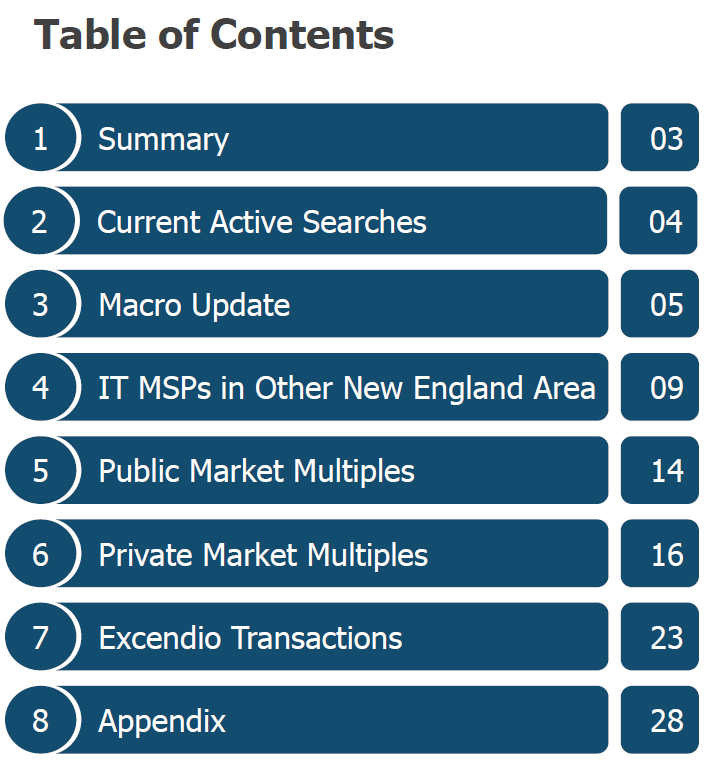
Finally, we analyze MSPs in the Other New England area (VT, NH, ME, RI). Cities like Portland (ME) and Providence (RI) are the sweet spot to target MSPs in the area. They have reasonable scale and higher than average SMB count per MSP.

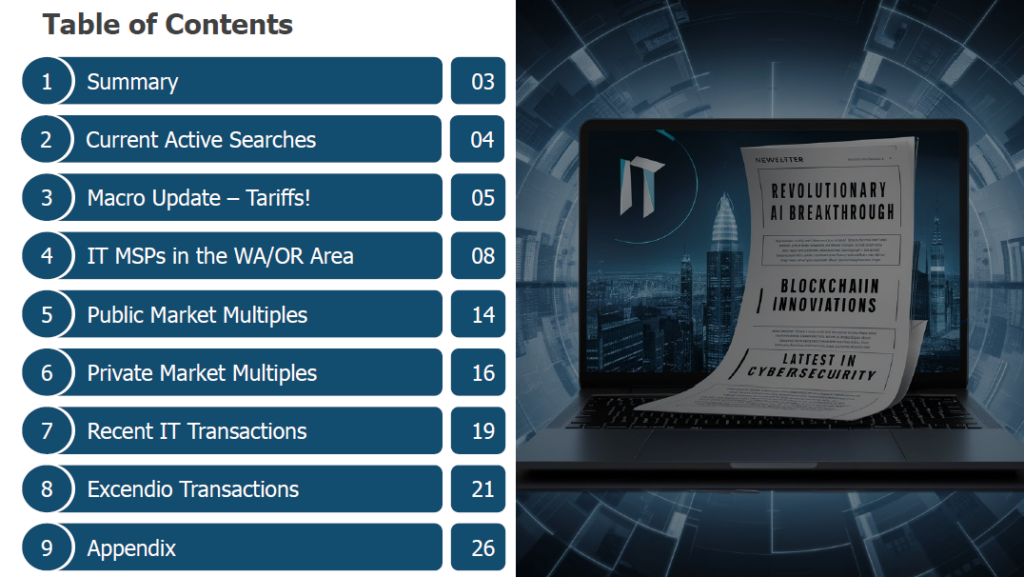
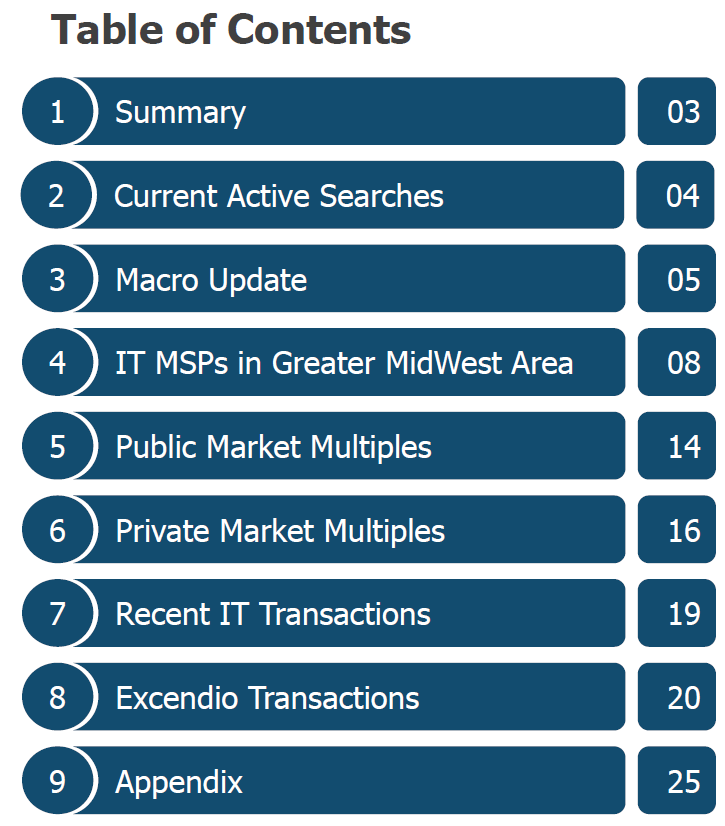
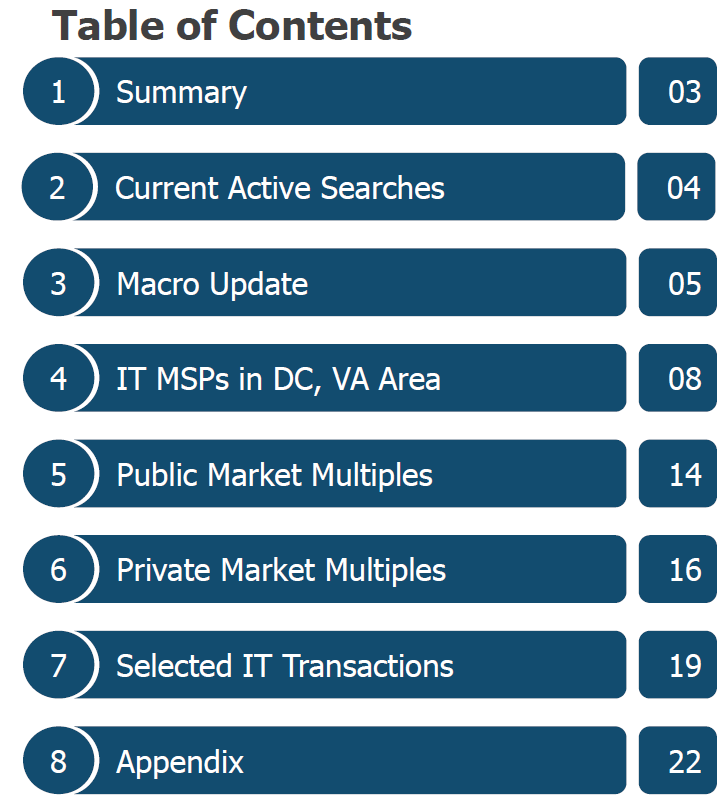
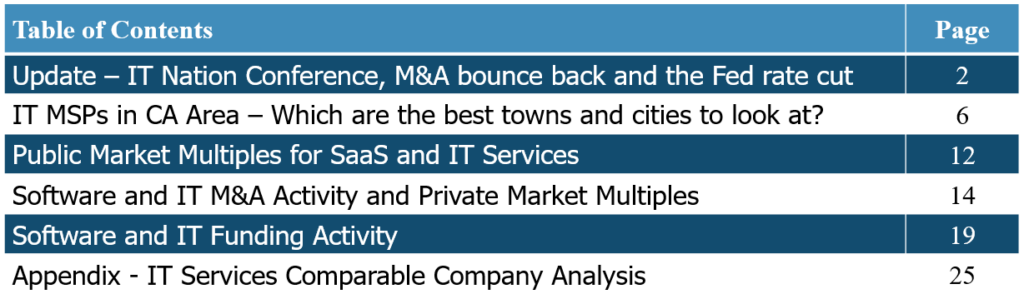
Excendio M&A Newsletter Table of Contents March 2025

Receive your copy of the March 2025 Newsletter by clicking here.

How MSPs Thrive in Healthcare

With Nelson Gomes, CEO and Founder of Portalia Group

In this episode, Nelson Gomes shares a masterclass on what it takes to be a high-performing MSP in the healthcare vertical. From EMR optimization and patient engagement to AI adoption and M&A strategy, Nelson breaks down how MSPs can move beyond maintenance to become true transformation partners for their healthcare clients.

Whether you’re looking to grow, specialize, or position your MSP for a successful exit, Nelson offers real-world insights drawn from decades of leadership in healthcare IT.

? Questions & Responses:

Q: From an MSP standpoint, what makes healthcare different in terms of the skill set required?
? Understanding the business of healthcare is critical — it’s not just fixing EMRs, it’s optimizing them and knowing the clinical workflows.

Q: How do specialist MSPs create more value than generalists?
? Specialists speak the same language as providers and win trust faster — 9 out of 10 times, they win the deal.

Q: What are healthcare organizations really looking for when selecting an MSP?
? Experience, expertise in healthcare systems, and a sense of security that their MSP “gets it.”

Q: What kind of background should MSPs build to succeed in healthcare?
? A strong healthcare foundation — either through EMR experience or supporting medical administration systems.

Q: Can you explain Gartner’s “Run, Grow, Transform” model?
? Most MSPs focus on “Run” — daily maintenance — but true value is created through “Grow” and “Transform” initiatives.

Q: What’s a real-world example of transformation in action?
? Helping practices adopt patient engagement apps — moving beyond IT support into strategic consulting.

Q: What role should MSPs play in M&A due diligence for healthcare?
? IT due diligence is often overlooked. Nelson helped create a 6-part framework to standardize and simplify this critical process.

Q: Should MSPs trying to enter healthcare build or buy?
? Buy. Acquiring a healthcare-focused MSP gives you immediate credibility, clients, and expertise.

Q: Where is AI playing the biggest role in healthcare today?
? Diagnostic imaging, like mammography. AI is powerful, but needs clinical oversight and thoughtful adoption.

Q: What healthcare tech events should MSPs attend?
? HIMSS, ViVE — critical for staying ahead of tech trends and industry expectations.

Q: What advice do you have for MSPs expanding into healthcare?
? Have a clear, well-thought-out strategy and the right people to execute it.

Q: How should smaller MSPs think about scale and specialization?
? If you’re not ready to scale, consider exiting at a good multiple to a larger player and learn from the experience.

Q: Grow solo or partner up?
? Joining a platform can accelerate growth — faster path to value creation than going it alone.

Q: Final takeaway for MSPs?
? Understand your value, define your personal goals, and have an advisor to guide you through transitions.

Hosted by Madhur Duggar, Senior M&A Advisor at Excendio Advisors, specializing in MSP M&A, valuations, and exit preparation.

Reach out to Madhur by email or 212.731.4230  

Book an Appointment with Madhur on LinkedIn

Check out Excendio Advisors and our amazing content at www.excendio2.sg.brads.dev

Reach out to Nelson Gomes on LinkedIn.


MSP M&A Uncovered

Inside Courser’s Acquisition Playbook with David Williams, VP of M&A

In this episode, host Madhur Duggar welcomes Dave from Courser to discuss the company’s M&A strategy, integration approach, and growth plans for 2025. Dave shares insights into Courser’s acquisition philosophy, emphasizing a strong focus on culture, leadership retention, and operational integration.

M&A Activity and Strategy
Courser, a PE-backed platform, has completed 16 acquisitions in the past two and a half years, including nine in 2024. The company aims to maintain or exceed that pace in 2025. Their acquisition targets range from $1M to $15M in revenue, with an average size of $7M-$7.5M. Courser is sector-focused, primarily acquiring MSPs and occasionally considering MSSPs with strong cybersecurity capabilities.

Integration Approach
Courser differentiates itself through its deep integration model. While externally the acquired company’s branding and leadership remain intact, internally, Courser standardizes back-office functions, finances, HR, and operations. They migrate all businesses onto a unified ConnectWise instance, creating a single-pane-of-glass view for management. This structured approach enables efficiency and scalability while ensuring a smooth transition for employees and customers.

Deal Structure
Courser typically structures its deals with a mix of cash and rollover equity (30-40%). Earn-outs are rare and used primarily in tuck-in acquisitions where revenue stability needs validation. They prioritize clear, seller-friendly structures that align incentives for long-term growth.

Challenges and Risks in M&A
Dave highlights common M&A risks, including leadership transitions, cultural misalignment, and integration challenges. He emphasizes the importance of talent and customer retention, especially as the industry undergoes significant consolidation. Courser mitigates these risks by focusing on culture, selecting growth-minded leaders, and ensuring operational stability post-acquisition.

Future Outlook
Looking ahead, Courser aims to continue its disciplined acquisition strategy, focusing on quality MSPs with strong leadership and recurring revenue. They also acknowledge the growing role of AI and automation in IT services and plan to enhance efficiencies through technological adoption.

The discussion concludes with reflections on broader industry trends, including the eventual exits of PE-backed MSP platforms and how integration strategies will play a key role in their long-term success.

Hosted by Madhur Duggar, Senior M&A Advisor at Excendio Advisors, specializing in MSP M&A, valuations, and exit preparation.

Reach out to Madhur by email or 212.731.4230  

Book an Appointment with Madhur on LinkedIn

Check out Excendio Advisors and our amazing content at www.excendio2.sg.brads.dev

Reach out to Dave Williams on LinkedIn


Excendio IT & Software Newsletter and Market Update

IT and Software M&A Market Update February 2025

Excendio Advisors IT and Software M&A Market Update February 2025

by Madhur Duggar, Excendio Advisors

In this issue we share current factors driving the current M&A environment, discuss the recent imposition of tariffs and how they are likely to impact MSPs, as well as analyze MSPs in the Washington / Oregon areas.

Excendio M&A Newsletter Table of Contents February 2025

Receive your copy of the February 2025 Newsletter by clicking here.

Cyber Insurance Uncovered: Protecting Small Businesses

Learn How Doug Kreitzberg at SeedPod is Working With MSPs to Protect Small Businesses from Digital Threats

Welcome to the next episode of my podcast M&A Insights titled “Cyber Insurance Uncovered: Learn How Doug Kreitzberg at SeedPod is Working With MSPs to Protect Small Businesses from Digital Threats”

Small businesses are increasingly the target of cyber threats, yet most remain dangerously underinsured. Only 10% have cyber insurance, and even fewer have the right coverage to survive a serious attack. So, how can Managed Service Providers (MSPs) step in to help?

To answer that question, I’m joined by Doug Kreitzberg, Founder and CEO of SeedPod Cyber. At SeedPod, Doug has developed an innovative program that help businesses proactively manage cyber risks. His team works closely with MSPs to ensure small businesses get the protection they need—before disaster strikes.

In today’s discussion, we’ll uncover the biggest misconceptions about cyber insurance, why small businesses struggle to get the right coverage, and how MSPs can play a pivotal role in bridging the gap. Doug will also share insights into SeedPod’s risk assessment process, the evolving landscape of cyber insurance pricing, and practical steps businesses can take to improve their cybersecurity posture.

If you’re an MSP looking to add value for your clients—or a business owner trying to navigate the complex world of cyber risk—this episode is for you.

Topics discussed on this podcast include:

Key Topics Discussed:

✅ Cyber Insurance Landscape for Small Businesses:

  • Are small businesses adequately insured against cyber risks today?
  • What are the risks of relying on general liability policies for cyber coverage?
  • What happens to small businesses that suffer multiple cyberattacks?

✅ Understanding Cybersecurity Risks:

  • Where does most cyber risk come from—bad software or bad deployment?
  • Who should own the deployment risk—software providers, businesses, or MSPs?

✅ Challenges in Cyber Insurance Adoption:

  • Are small businesses qualified to purchase cyber insurance on their own?
  • Why do many brokers lack the expertise to properly guide businesses on cyber policies?

✅ The Role of MSPs in Cyber Insurance:

  • How does SeedPod Cyber work with Managed Service Providers (MSPs)?
  • What role do MSPs play in educating small businesses about cyber risks?
  • How does SeedPod validate MSPs through security assessments?

✅ Key Components of a Comprehensive Cyber Insurance Policy:

  • Liability coverage: What does it protect against?
  • First-party costs: What expenses are covered after a cyber incident?
  • Loss of income coverage: How does it help businesses recover financially?
  • E-fraud coverage: How does it protect against social engineering scams?

✅ Cyber Insurance Pricing & Risk Assessment:

  • How are insurance companies currently pricing cyber risks?
  • What are the challenges in developing actuarial models for cyber insurance?
  • How does SeedPod’s risk assessment process work, and what does it evaluate?

✅ Regulatory & Security Best Practices:

  • Can regulations improve the cybersecurity landscape?
  • How should regulations hold software developers and MSPs accountable?
  • What are the basic steps businesses should take to improve cybersecurity?

Hosted by Madhur Duggar, Senior M&A Advisor at Excendio Advisors, specializing in MSP M&A, valuations, and exit preparation.

Reach out to Madhur by email or 212.731.4230  

Book an Appointment with Madhur on LinkedIn

Check out Excendio Advisors and our amazing content at www.excendio2.sg.brads.dev

Reach out to Doug Kreitzberg on LinkedIn


IT Nation Unplugged: Growth, Exit & Legacy

Arlin Sorensen on Navigating Growth, Exit & Legacy as an MSP Owner

In this episode of M&A Insights, I sit down with Arlin Sorensen at IT Nation ConnectWise to explore the evolution of IT Nation, discuss the biggest challenges facing MSPs today, and how Arlin thinks MSP owners should approach their inevitable transition be it through sale, transfer to a family member or to an ESOP.

Arlin shares invaluable insights from his decades of leadership experience, making this a must-listen for MSP owners, IT leaders, and anyone thinking about the future of their business.

In this podcast we discuss the following questions:
IT Nation’s Role in the MSP Ecosystem – its mission, vision, and impact on MSPs

Leadership – Advice for MSP owners looking to develop their leadership skills
Acquisition and Growth– Insights for MSPs looking to grow inorganically
Industry challenges – Tackling cybersecurity threats and IT talent shortages
Post-exit challenges – Challenges MSP owners face in transitioning to retirement including lack of financial planning and a loss of identity post-retirement
Future of IT Nation – Upcoming innovations at IT Nation and the establishment of a global footprint

Personal Insights – Leadership philosophy, the upside-down triangle and Arlin’s legacy

Key Risks facing MSPs– The importance of thinking about your mental and physical health

Hosted by Madhur Duggar, Senior M&A Advisor at Excendio Advisors, specializing in MSP M&A, valuations, and exit preparation.

Reach out to Madhur by email or 212.731.4230  

Book an Appointment with Madhur on LinkedIn

Check out Excendio Advisors and our amazing content at www.excendio2.sg.brads.dev

Reach out to Arlin Sorensen on LinkedIn


What MSPs Should Know About M&A

Channel Partners TV: What MSPs Should Know About M&A

CP Expo - MSP Summit 2025 Vegas


Channel Partners TV: What MSPs Should Know About M&A

Ahead of the Channel Partners Conference and MSP Summit, Cristian Anastasiu, Managing Partner of Excendio Advisors, was invited to an exclusive interview covering “What MSPs Should Know About M&A”.

In the interview, professional insights were provided to the following questions and more:

  1. What is the current state of the MSP M&A market?
  2. When should a business owner start to think about an exit plan and why?
  3. What have you learned from owners who sold their business?
  4. What is the one piece of advice you would give a business owner?


Achieving Operational Maturity as an MSP

A Conversation with Sean Maguire, President and Founder of Synivate

In this episode of M&A Insights, I sit down with Sean Maguire, president and founder of Synivate, to explore the journey of building and scaling a successful MSP. Sean shares his insights on standardizing service delivery, cybersecurity best practices, and the role of M&A in strategic growth. Whether you’re an MSP owner looking to improve operational efficiency or an investor exploring opportunities in the space, this conversation offers valuable takeaways.

Topics Discussed & Key Questions:
The Evolution of Synivate: How did Sean transition from voice and data cabling to a full-fledged MSP?
Challenges in Scaling an MSP: What were the biggest obstacles in growing the business, and how were they overcome?
Standardization & Operational Maturity: Why is having a structured, repeatable process critical for MSPs?
Cybersecurity & Compliance: How does Synivate ensure its clients meet evolving security standards and regulations?
Cyber Insurance & Liability: What should MSPs be thinking about in terms of coverage and legal protections?

Growth from Referrals: What are Centers of Influence and why do they make for the best referrals?
M&A Strategy: What role does M&A play in Synivate’s growth plan, and what challenges come with acquiring other MSPs?
Supply Chain Security is a Key Risk: What are the biggest threats MSPs should be preparing for in the next few years?

The Future of IT & AI: How is AI impacting the MSP landscape, and what does Sean see as the next big shift?

? Tune in to gain actionable insights on growing and scaling your MSP the right way!

#MSP #Cybersecurity #MergersAndAcquisitions #BusinessGrowth #Podcast #ITServices

Hosted by Madhur Duggar, Senior M&A Advisor at Excendio Advisors, specializing in MSP M&A, valuations, and exit preparation.

Reach out to Madhur by email or 212.731.4230  

Book an Appointment with Madhur on LinkedIn

Check out Excendio Advisors and our amazing content at www.excendio2.sg.brads.dev

Reach out to Sean Maguire on LinkedIn


Excendio IT & Software Newsletter and Market Update

IT and Software M&A Market Update – January 2025

Excendio Advisors IT and Software M&A Market Update – January 2025

by Madhur Duggar, Excendio Advisors

In this issue we share current factors driving the current M&A environment, review the potential impact of the new administration on M&A, as well as analyze MSPs in the Greater Midwest areas.

Excendio M&A Newsletter Table of Contents January 2025


Receive your copy of the January 2025 Newsletter by clicking here.

John Allen Welcome Announcement

Excendio Advisors Welcomes John Allen as Senior Advisor

Excendio Advisors is excited to announce that John Allen has joined our team as a Senior M&A Advisor.

He is a CPA and has over 30 years of direct P&L and general management experience. His diverse background includes a unique combination of operations, financial, and sales management, which has enabled him to lead companies to dramatic increases in revenue and profitability.

He has served as President, General Manager, and Chief Financial Officer at a Phoenix-based IT services company.

He has an extensive sales background and has closed numerous transactions in the technology sector and integrated acquisitions.

John graduated from Northern Arizona University with a Bachelor of Science in Accountancy.

From Bullfighter to COO: Driving Operating Profit

Listen to How Ethan Farlow is Taking the Bull by its Horns at ComTech to Drive Operating Profitability

In this episode, we dive into the inspiring journey of Ethan Farlow, COO at Comtech Network Solutions. From his early days assembling computers and a stint as a professional bullfighter to leading operations at his family-run IT services firm, Ethan shares how he’s cracking the whip to drive operating profitability. Learn how ComTech leverages data, automation, and client-centric strategies to streamline operations, negotiate with vendors, and scale sustainably. Packed with actionable insights on standardization, hiring best practices, and the future role of AI in MSPs, this conversation is a must-listen for anyone looking to optimize their business for growth and efficiency.

Topics discussed include:

  • Ethan Farlow and Comtech Solutions: A Family Legacy
  • Driving Efficiency Through Standardization
  • Leveraging Data for Vendor Negotiations – It’s All About Confidence
  • Key Performance Indicators That Matter – Time per Endpoint per Month!
  • Data-Driven Automation – Using Videos to Automate Workflows  
  • Best Practices for Hiring – How to Attract the Right People
  • Offshoring: Current Views and Future Plans – Keeping All Options Open
  • Cross-Selling and Upselling Through Data Analysis – Keep a Client Matrix 
  • Navigating the Future with AI – Mastering Unstructured Data
  • Advice for MSP Leaders – Know Your Cost to Push Price

Hosted by Madhur Duggar, Senior M&A Advisor at Excendio Advisors, specializing in MSP M&A, valuations, and exit preparation.

Reach out to Madhur by email or 212.731.4230  

Book an Appointment with Madhur on LinkedIn

Check out Excendio Advisors and our amazing content at www.excendio2.sg.brads.dev

Reach out to Ethan Farlow on LinkedIn


Why 2025 Could be the Best Time to Sell your MSP

?️ Podcast Alert: Why Now is the Perfect Time to Sell Your MSP!

Are you an MSP owner in the $2M-$5M revenue range? Discover why 2025 might be your golden window to exit. In this episode, Madhur Duggar shares 4 key reasons to consider selling now:

1️⃣ Peak Market Conditions: Public and private market valuations are at all-time highs and good news is bad news.
2️⃣ Slowing Post-COVID Growth: Peak growth has occurred. IT demand is stabilizing, with increased competition on the horizon. The ratio of SMBs to MSPs is going to decrease.
3️⃣ The AI Revolution will favor larger MSPs with Industry Expertise: Clients need advice on how to use to AI to grow. Do you have industry expertise in their sector?
4️⃣ Buyer-Seller Imbalance: Too many sellers, too few buyers. Get out before the MSP exit tsunami gets here.

? Packed with insights, data, and real-world examples, this is a must-listen for MSP founders ready to make a strategic move.

Hosted by Madhur Duggar, Senior M&A Advisor at Excendio Advisors, specializing in MSP M&A, valuations, and exit preparation.

Reach out to Madhur by email or 212.731.4230  

Book an Appointment with Madhur on LinkedIn

Check out Excendio Advisors and our amazing content at www.excendio2.sg.brads.dev


Why 2025 Could be the Best Time for MSPs to Sell

Why 2025 Could be the Best Time for MSPs to Sell

by Madhur Duggar, Excendio Advisors

This article delves into the four key reasons why 2025 moment might be a prime opportunity for MSPs in the $2 million to $5 million revenue range to exit.

  1. Markets Are at a Peak

Public market performance often influences private market valuations. Over the past five years, major indices have experienced extraordinary growth: the S&P 500 is up 80%, and the NASDAQ has risen 115%. However, much of the positive momentum has already been priced in, and market behavior now signals potential volatility.

For instance, despite strong job creation numbers released on Feb 10th, 2025, by the Bureau of Labor Statistics—265,000 jobs added versus an expected 155,000—both the S&P 500 and the Dow Jones Industrial Average experienced a 1.5% decline on the same day. Markets read this piece of particularly good news as a sign the Fed would slow down its pace of rate cuts. This reaction underscores concerns about future interest rate hikes, higher discount rates, and the resulting downward pressure on valuations. Market volatility will also drive a wedge between buyers and sellers slowing down the pace of M&A.

  1. Post-COVID Growth Tailwinds Are Slowing

The post-pandemic period ushered in rapid IT adoption, driven by trends such as remote work, cloud migration, and digital transformation. This led to high growth rates for MSPs, with some achieving top-line growth in the 15-20% range. However, this explosive growth is beginning to normalize. Recent data from Service Leadership suggests growth rates are likely to stabilize around 10% going forward. Slower growth will imply lower multiples.

The number of small and medium-sized businesses (SMBs) per MSP is also expected to decline as MSPs are growing faster than SMBs. Currently, 30% of MSPs are growing headcount at 10% or more annually, compared to only 15% of SMBs. As more MSPs compete for a limited pool of SMB clients, pricing pressures and competitive intensity will only increase, making it harder for smaller MSPs to sustain their growth.

  1. The AI Revolution Will Favor Larger MSPs

Artificial intelligence is transforming the MSP landscape, shifting client expectations from technical support to strategic advisory services. Clients now seek MSPs that can guide them on incorporating AI into their operations—from improving customer experiences to automating back-office functions. However, acquiring the expertise required to meet these demands poses significant challenges for smaller MSPs.

Nelson Gomes of The Portalia Group noted that only about 100 MSPs nationwide possess the scale and expertise to provide AI-driven strategic advice in the healthcare sector. This equates to just two qualified MSPs per state! Smaller MSPs face significant hurdles in attracting and retaining the talent necessary to compete in this advisory-driven market, further disadvantaging them compared to their larger counterparts.

  1. Too Many Sellers, Too Few Buyers for Smaller MSPs

The sheer volume of MSPs in the market underscores the urgency for smaller players to act now. There are approximately 60,000 MSPs in the U.S., with only 10% employing more than ten people. Seventy-five percent of these, i.e., 4,500 MSPs have revenues in the $2 million to $5 million revenue range.

Assume there are fifty serious serial buyers actively pursuing acquisitions in this segment. If each buyer were to acquire 10 MSPs annually—a brisk pace—it would take nine years to process the existing pool of potential sellers! This timeline does not account for the thousands of smaller MSPs that will grow into this revenue range over the next five years, further saturating the market. As the supply of sellers continues to outpace demand, buyers will adopt programmatic approaches with standardized multiples, leaving little room for premium valuations.

Final Thoughts

For MSP founders considering an exit, the arguments are clear. Market conditions are favorable, growth tailwinds are diminishing, AI-driven transformation demands scale, and the supply-demand imbalance in the M&A market will only worsen. By acting now, smaller MSPs can capitalize on peak valuations and secure a strategic exit before market dynamics shift further against them.

MSP Builder Unplugged: Turning Alerts into Opps

And Chaos into Control with Guy Baroan and Glenn Barnas

In this episode of M&A Insights, we dive deep into the transformative power of automation for Managed Service Providers (MSPs) with the team behind MSP Builder. Discover how their innovative solutions help MSPs save time, reduce costs, and streamline operations. From tackling alert fatigue to boosting ROI through intelligent automation, we explore how MSP Builder is redefining success for MSPs of all sizes. Whether you’re a seasoned professional or new to the MSP landscape, this episode is packed with actionable insights and forward-thinking strategies.

Questions Covered in the Episode:

  1. What inspired the creation of MSP Builder, and how did it all begin?
  2. What makes MSP Builder unique in the crowded MSP tools market?
  3. How does MSP Builder tackle common challenges like alert overload and patch management?
  4. What role does MSP Builder play in simplifying RMM migrations?
  5. How does MSP Builder deliver a measurable ROI for MSPs?
  6. What trends and advancements in automation are shaping the MSP industry’s future?
  7. What advice would you give to MSPs implementing RMM platforms today?
  8. What risks or challenges do you think the MSP sector is underestimating for the future?

Hosted by Madhur Duggar, Senior M&A Advisor at Excendio Advisors, specializing in MSP M&A, valuations, and exit preparation.

Reach out to Madhur by email or 212.731.4230  

Book an Appointment with Madhur on LinkedIn

Check out Excendio Advisors and our amazing content at www.excendio2.sg.brads.dev

Learn more about MSP Builder at www.mspbuilder.com


Five Emerging Risks in IT You May Not Be Thinking About

Five Emerging Risks in IT You May Not Be Thinking About

Five Emerging Risks in IT You May Not Be Thinking About

by Madhur Duggar, Excendio Advisors

As we kick-start 2025, the IT landscape is rapidly evolving, bringing a new wave of challenges and opportunities.

The white paper, titled “Five Emerging Risks in IT You May Not Be Thinking About“, reviews five critical risks that the IT community isn’t discussing enough, but should, as we prepare for the future.

Getting Reverse Due Diligence Right

Getting Reverse Due Diligence Right – Questions for Sellers

Getting Reverse Due Diligence Right – Questions for Sellers

by Madhur Duggar, Excendio Advisors

In the world of mergers and acquisitions (M&A), due diligence has traditionally focused on buyers scrutinizing sellers. Buyers analyze financials, operations, and potential risks before finalizing a deal. However, a crucial aspect often overlooked by sellers is “reverse due diligence” — the process by which sellers vet potential buyers. Just as buyers need to ensure they are acquiring a solid business; sellers must ensure they are partnering with the right buyer to achieve their goals.

The white paper, titled “Getting Reverse Due Diligence Right – Questions Sellers Should Be Asking Buyers“, provides an actionable framework for sellers to navigate the M&A process with confidence. It underscores the importance of cultural fit, growth opportunities, post-sale career paths, and transaction structure to ensure a mutually beneficial deal.

Acquisition Announcement: MSP / Cyber Security

New York, NY November 5, 2024

Excendio Advises eDot on its Acquisition by Cyber Advisors

Excendio Advisors has announced that eDot, LLC has been acquired by Cyber Advisors, LLC. Excendio served as eDot’s exclusive financial advisor for this successful transaction.

eDot, founded in Wheeling, IL by Steve Jaffe and Melvin Thoede more than 20 years ago, specializes in Managed Services, Cyber Security, Backup Systems, IT Consulting, and Hardware/Software Sales and Support. Cyber Advisors is a prominent provider of cybersecurity and technology solutions, offering industry-leading Managed Service Solutions complemented by a comprehensive Cyber Security portfolio with specialized operations in Chicago, Minneapolis/ St. Paul and Fargo.

I am thrilled about our partnership with Steve and Melvin at eDot which is set to bring unparalleled value and service to our clients in the Chicago and Southern Wisconsin markets. By combining our expertise, we will not only enhance our offerings but also provide additional security benefits to their customers and expanded coverage to ours” said Shane Vinup, CEO at Cyber Advisors.

Melvin Thoede, Partner of eDot, remarked, “When I met with the head of cyber security for Cyber Advisors, I was just blown away. The products and services we can now offer our 150+ clients are tremendous.”

We met Cristian Anastasiu of Excendio many years ago, when we were acquiring companies. Over the years, he gained our trust, and we were impressed by his industry knowledge. Melvin and I came to this process with very high expectations and the team at Excendio did not disappoint. Cyber Advisors is a perfect partner for us, and we are very excited about the opportunities ahead” added Steve Jaffe.

The market for MSP businesses continues to be very active and given the size of the market and number of small MSPs we might be just seeing the tip of the iceberg. As customers’ expectations and demands grow, automation and economies of scale become a competitive factor that will inevitably lead to continued consolidation” commented Cristian Anastasiu, Excendio’s Managing Partner.

For more information about Cyber Advisors and its services, please visit  https://cyberadvisors.com.

To learn more about eDot, please visit https://edotsolutions.com.

Excendio Advisors is a lower middle market M&A advisory firm focused exclusively on IT Services and select Software areas, with more than 20 years of successful Mergers & Acquisitions experience. We deliver world-class M&A advisory and have earned an outstanding reputation by leveraging our industry expertise and a network built over more than 30 years.

https://www.prweb.com/releases/excendio-advisors-msp-acquisition-announcement-edot-acquired-by-cyber-advisors-302297128.html

Excendio Advisors Welcomes Madhur Duggar as a Senior Advisor

Excendio Advisors Welcomes Madhur Duggar as a Senior Advisor

Excendio Advisors is excited to announce that Madhur Duggar has joined our team as a Senior M&A Advisor.

Madhur brings to our clients more than 20 years of experience in middle market IT and software Mergers & Acquisitions Consulting.

His experience includes successful transactions at firms like Citibank, Barclays and KPMG as well as work on a range of strategic initiatives including valuation, financial planning, restructuring and working capital optimization.

Madhur is a UC Berkley, Haas School of Business alumnus and lives with his wife and son in New Jersey.

Now Micro acquired by Trafera

Acquisition Announcement: Educational Technology Solutions

New York, NY October 8, 2024

Excendio Advises Now Micro on its Acquisition by Trafera

Excendio Advisors has announced that Now Micro, Inc. headquartered in Mendota Heights, MN has been acquired by Trafera. Excendio served as Now Micro’s exclusive financial advisor for this successful transaction.

Founded more than 30 years ago by Patrick Finn and Bob Milam and known for its core belief that “Because Now Matters”, the company has been a trusted partner in delivering tailored, purpose-built technology solutions to SLED and commercial enterprises encompassing hardware, software, and services.

Trafera is a leading provider of educational technology to K-12 schools. With headquarters in Arden Hills, MN, and repair facilities across the United States, Trafera has established itself as a trusted partner for buying, deploying, repairing, and supporting classroom technology. Trafera is a Rotunda Capital Partners portfolio company.

We are very excited to be joining forces with the team at Trafera. This represents an important next step in our growth and will enable us to offer a broader range of services and solutions to our customers as well as opportunities to our employees,” said Pat Finn. “The similar company cultures, the personal touch were key factors that led us to this selection” added Bob Milam.

“We are very thankful to the Excendio team for their relentless work, for guiding us through this process and finding the best partner. We would certainly want them on our side if we had to do it again. Cristian Anastasiu and his team are very good at what they do”, commented Pat and Bob.

Excendio Advisors is a lower middle market M&A advisory firm focused exclusively on IT Services and select Software areas, with more than 20 years of successful Mergers & Acquisitions experience. We deliver world-class M&A advisory and have earned an outstanding reputation by leveraging our industry expertise and a network built over more than 30 years.

Read the press release here:

https://www.prnewswire.com/news-releases/trafera-acquires-now-micro-strengthening-commitment-to-innovative-technology-solutions-302270683.html

Not Rocket Science

M&A and IT Due Diligence: Part One – It’s not Rocket Science

M&A and IT Due Diligence: Part One – It’s not Rocket Science

By Bill Vinck, Excendio Advisors

M&A and IT Due Diligence: Part One – It’s not Rocket Science…some think it might be a little harder

Background

The Information Technology Ecosystem (ITE) is a complex area that should receive a great deal of very specific attention during M&A due diligence. The ITE is itself a rapidly evolving universe and the due diligence process that reviews it should reflect that complexity. Failures in this area can threaten the M&A investment thesis.

In this article we’ll review the standard checklist approach which is clearly necessary; but we’ll argue that it is dangerously insufficient. We’ll review one area in which the insufficiency is pronounced. In subsequent articles, we’ll review five additional areas.

Check lists? Necessary but are they Sufficient?

Standard Industry check lists on IT due diligence are often helpful and correct. Here’s an abbreviated example:

One should collect the following information:

  • Details of any current and planned IT initiatives/key projects.
  • Summary of key IT resources (hardware/software/people).
  • Policies and practices for the purchase and maintenance of software.
  • Summary of all material software utilized by the target firm.
  • Policies and practices regarding the purchase and maintenance of IT hardware.

This type of review is important in that, as an acquirer, one is getting a suite of IT related assets and it’s important to know what one has acquired. This is an important administrative step and it’s a necessary step. But as an aggregate of data, how helpful is it?

Our argument is that while necessary, such an approach is insufficient. This insufficiency potentially distorts the value, up or down, of the acquired company as well as the costs and risks of company integration. In turn, this insufficiency obscures a clear understanding of the strategic value of the proposed transaction.

Think of the ITE as analogous to the central nervous system of an organism. The overall health and smooth operation of the CNS is critical to the successful life of that organism; problems there comprise the function and, eventually, the life of the organism.

The standard industry check-list approach, while necessary, can fail to disclose key elements of the ITE. By following such an approach to IT due diligence in an M & A transaction, the buyer may not fully understand the ramifications of their purchase. In what follows we add several major topics to the IT due diligence scope to illustrate the problem. These topics help the acquiring firm move beyond necessity and approach sufficiency. These topics share several characteristics:

  • In-depth understanding of them is critical to successful business integration.
  • They are critical points of intersection between technology and the operations of the business.
  • They require detailed technical, process, and business analysis beyond simple data gathering.
  • Findings in these areas can materially alter deal terms and even raise questions of deal desirability.

There are six major topics to be considered. We’ll deal here with the first topic and will discuss the others in subsequent articles. The major topics that address the sufficiency issue are the following:

  • Company Technology Culture.
  • Supply Chain Relationships.
  • Cyber Risk Management.
  • Competitive Advantage Readiness.
  • AI and IP.

Company Technology Culture

Both parties to an M&A transaction have a company culture and may acknowledge the need to understand those cultures as a preamble to the integration of the firms. Both firms also have an IT culture that must be integrated sooner or later. As there can be major differences between company cultures, that possibility exists as well in the ITE subculture. In many ways, the ITE sub-culture can be either a major enabling institution or a potential obstacle to transaction success. Knowing in advance which it will be is critical.

What is an IT culture?

It is:

A way of thinking about technology

What role does IT play in the firm today? The standard answers, of course, are versions of “IT is critical to our business, etc.” These days who would maintain IT is trivial? But wherein does this criticality lie? The due-diligence analyst must dig for examples as they will demonstrate a key linkage between senior leadership and IT leadership. This linkage reveals the quality and sophistication of the relationship between senior leadership and IT leadership. It is a report card on the success of that relationship.

A fondness for certain vendors and tools

Some IT organizations have adopted tools after exhaustive analysis and a detailed mapping of product capabilities to defined requirements. Others are less formal. The acquiring firm will likely see some difference of opinion in technology selection which must be addressed in the integration plan. Platform and tool integration can be a significant and sometimes hidden area of emotion and expense. A joint target technical architecture is a likely post-acquisition integration project. Vendor and tool “fondness” can easily provide challenges during integration. Such challenges result in increased time expenditures and increased cost both of which hurt the investment thesis.

A suite of relationships with certain vendors and an avoidance of others

Product excellence is only one of several ways vendors have of establishing and sustaining relationships with IT leadership. Understanding how product decisions were made reveals many things not the least of which the quality of IT leadership in the acquired firm. Similar to the above point on “fondness”, this area can reveal insights on the IT leadership team.

A way of making decisions about projects and an approach to project management

IT leadership has heavy doses of project management embedded. Few business functions spend more time managing projects than IT. How is it done? Is there a standard approach used by all project leaders? How is project status communicated to senior leadership? A seemingly straight-forward technical implementation may raise business operational issues. How adept is IT leadership at recognizing and framing these matters for senior attention?

A way of dealing with company management vendors, and customers

Most companies have a technical architecture for communications with outside business partners. What does this architecture do? How is it managed? Can it be seen as robust, i.e. supporting interactions beyond the current demand? Would one describe this architecture as sophisticated or elegant or it something cobbled together reflective of limited budget and unimaginative technical design?

A set of beliefs on what priorities exist

Every leadership team has a conversational grasp of the firm’s business and IT priorities. What are they? What does the description of these priorities say about the intimacy and depth of the communications between business leadership and IT leadership? If this depth could be quantified there would be a direct positive relationship between great depth and IT success.

An approach to finance and financial control

IT leadership spends a lot of money. How do they think about it? How do they justify various expenses? Look at a proposal for a new project and ask “How is this justified?” Is there a compelling depth of analysis that would persuade rational but skeptical leaders? Have the depressingly standard cliches been avoided?

A pace of work energy and a style of leadership

There is an organizational energy in every IT organization. That energy reflects, among other things, the morale of the staff, the quality of the leadership, and the confidence of all that important work is being done. So how can that energy be described? One can watch it daily as the IT staff goes through their day. Project meetings can display energy or its’ lack. Communications, formal or informal, with senior leadership are a leading energy indicator. What is their frequency? Intensity?

Attitudes towards learning

Of course, it’s commonplace to describe the IT universe as constantly changing. How does the target firm approach that fact? How is staff training structured? How are new technologies introduced? Professional development in some organizations is non-existent. In others it’s highly unstructured, i.e. a staff member selects a program and attends…box checked.

Conclusion

IT due diligence checklists can be robust and detailed. Our argument here has been that while necessary, the typical checklist may be insufficient in that it fails to deal adequately with the six topics mentioned above. Dealing with these topics requires judgement, experience, and an ability to observe a broad spectrum of phenomena. The leader responsible for the IT component of due diligence should be armed with the tools, background, experience and management support to conduct the needed analysis. Failing that review jeopardizes the transaction.

As the great philosopher Mick Jagger put it: “ You can’t always get what you want, but if you try sometimes, you might just get what you need.”

Is This a Good Offer?

BY CRISTIAN ANASTASIU

Most certainly every business owner who has considered selling their business and has received offers has asked themselves: “Is this a good offer?”  Leading to the inevitable question of: “Should I accept it?”   Often during an engagement our clients ask us these exact questions:  how should an owner evaluate an unsolicited offer, keeping in mind that a “good” offer is different from a “fair” offer.

An offer to acquire a business can be very complex:

    • the financial part alone can include multiple components: cash at closing, earnout, note, equity, working capital, etc.;
    • then there are many terms and covenants (non-compete, escrow, reps and warranties, etc.);
    • and finally, there is the chemistry with the buyer, the cultural fit, synergies, the track record and the probability of the buyer being able to close, the owner’s legacy, the future of the company, its employees and customers, etc.

While many business owners are up to date on comps or market metrics, such as multiple of ebitda or multiple of revenues or discounted cash flow, most have their own opinion of what the business is worth. That is: worth to them. Even when using formulas to determine the valuation, there is room for interpretations, such as what exactly goes into adjusted ebitda, what is the actual recurring revenue, and so on. Couple these statistics with the timing aspect, and the complexity increases.

For example, an owner may think that if they wait a few months or years on accepting an offer:

    • the company’s valuation will increase (due to the market conditions, the company performance, etc.);
    • the owner will continue to earn salary and dividends running and owning the company;
    • and fetch a higher price when selling sometime in the future.

We believe that the question “Is this a good offer?” should be answered by the sellers themselves, depending on how the offer compares to their goals, objectives, and timing.

With this complexity in mind, we address the VALUATION GOAL vs EXIT TIMING dilemma and ask:

Are you targeting a certain valuation for your business and are you willing to wait until you receive an offer matching that amount, even if that means waiting a few more years or longer?

OR

Are you interested in selling now, run a robust sale process, and select the best offer you will receive, knowing that it reflects the current market value of your business?

If you are in the first category, the answer to the question “Is this a good offer?” is relatively simple. Either the offer matches your financial goal or not.

If you are in the second category, which many of our clients are, we suggest you weigh some additional factors before deciding to negotiate, accept, or pass on an offer.

      1. Is this the best offer we can expect from this specific buyer? Can we improve the offer or did the buyer signal that this is how far they are willing to go? Is there a particularly good fit with this buyer which is hard to replicate with others?
      1. Is this the best offer we can expect now and in the near term from any potential buyer? How many offers have we received so far and were they in the same range? How long have we run the sale process? What are the market trends? Are your revenues and profitability growing and is that a reason to expect the next offer to be better?
      1. If the answer to the questions above are YES but this offer is not in the range of what you believe the business is worth, given the market and the company’s projections, how long will it take until we can realistically expect to receive an offer matching your goals? Months? Quarters? Years? What are the odds that you will receive the desired offer within a given timeframe? Are you willing to make the tradeoff of passing on this offer in exchange for a future offer and postpone your exit, maybe indefinitely? What are the implications?

Ultimately how “good” an offer is, is mostly a function of the seller’s expectations. By breaking down the complexity of a decisive question like “Is this a good offer?” into simpler and measurable parts, owners can make a more informed decision which years later they know was the right one.[/et_pb_text][/et_pb_column][/et_pb_row][/et_pb_section]