Tag: Excendio Advisors

What role does Working Capital play in M&A transactions?

What role does Working Capital play in M&A transactions?

Working capital in M&A is a somewhat neglected and misunderstood topic. Buyers and sellers often have different expectations. As a result, we recommend that this topic be addressed early in negotiations, and definitely before signing an LOI. The LOI should clearly indicate the purchase price and other terms (cash at closing, earnout, employment agreements, escrow, etc.) as well as the amount of required working capital at closing that the seller will deliver as part of the transaction.

In general, working capital, also known as net current assets or NCA, equals current assets (cash, accounts receivable, etc.) minus current liabilities (accounts payables, accrued and deferred expenses, line of credit, current portion of long-term debt, etc.).

In M&A transactions, the Target (or Required) Working Capital comes into play. Simplified, the target working capital is the minimum amount of working capital, on a cash-free and debt-free basis, required at closing such that the buyer can operate the business post-closing without the need to add any cash or debt. The closest analogy would be the “gas in the tank” any car buyer expects from the dealer when buying a car and driving off the lot.

Many business owners struggle with the idea of “leaving” money behind that they believe is theirs. However, the working capital cannot be separated from the business. The purchase price a buyer offers is for a “going concern” and assumes that there is enough on the Balance Sheet to allow the business to continue to operate in the foreseeable future.

Technically, on a cash-free / debt-free balance sheet, the Equity, which includes Retained Earnings, equals Current Assets minus Current liabilities, which is working capital. If the seller was to “keep” the equity, there would be no working capital left for the new owner to run the business.

Current Assets 100 Current Liabilities 50
Equity 50
Total Assets 100 Total Liabilities and Equity 100

Calculating the Target Working Capital (TWC) is mostly a science, but also an art because each situation is different and is subject to interpretation and negotiation: Which period should be used? TTM (Trailing Twelve Months) before closing or the most recent calendar year? How should the amount be determined if there is an earnout? Or rollover equity? How should deferred revenue be treated? What if revenues are decreasing or increasing? How are accounts receivable that are more than 120 days past due treated? How are short-term spikes in the level of working capital treated?

As mentioned, an offer to acquire a business should include next to the purchase price and other terms the amount of working capital required at closing calculated on a cash-free / debt-free basis as an average of the monthly working capital in a given period, like TTM, the last calendar year, etc.

Finally, on the day of closing, the Net Working Capital is determined and the purchase price/ cash at closing amount is adjusted dollar for dollar depending on if the Net Working Capital is lower or higher than the Target Working Capital. Typically, after 90 days a true-up takes place, to determine the final working capital at closing and the necessary adjustment.

How are the target working capital, the adjustment at closing, and the amount the seller receives from the Balance Sheet calculated?

Below are the steps related to the treatment of the Working Capital. In addition, we can provide you with a real-life Excel-based calculation that you can request by sending us an email at ved.sdarb.gs.2oidnecxeobfsctd-417050@sregrem

Start with 12 monthly Balance Sheets side by side in an excel. Separate in two columns:

  1. The cash-free / debt-free line items the seller will deliver to the buyer at closing (Current Assets including accounts receivables, prepaid expenses, inventory; Current Liabilities including accounts payable, accrued liabilities, deferred revenues, etc.), and
  2. The line items the seller will be responsible for at closing (cash, shareholder notes, line of credit, long-term debt, etc.).

Next step: Determine the 12 months average of the items in column 1. The Target Working Capital equals the sum of all averaged current assets selected in column 1 minus the sum of all averaged current liabilities selected in column 1.

The Net Working capital at closing is the difference between the current assets and current liabilities line items identified in step 1 above on the day of closing.

At closing, the purchase price is adjusted on a dollar-for-dollar basis depending on if the Net Working Capital is lower or higher than the predetermined and agreed Target Working Capital.

What are the net proceeds for the seller from the Balance Sheet at closing? To determine this amount, first calculate the difference between the assets and liabilities in column 2 (which represents the items that are the seller’s responsibility at closing).  The net impact for the seller from the Balance Sheet at closing is the sum of the working capital adjustment and the amount representing the seller’s responsibility. The net impact can be a positive or negative amount.

Finally, 90 days after closing a true-up takes place, after the Actual Working Capital at closing has been determined.

Other sources discussing Working Capital in Mergers & Acquisitions transactions that we found very relevant include:

https://www.bdo.com/insights/business-financial-advisory/m-a-and-transaction-advisory/importance-of-net-working-capital-(-nwc-)-in-m-a

https://www.gouldratner.com/assets/publications/BBG_Working-Capital-Adjustments-in-MandA-Transactions-Navigating-a-Minefield.pdf

BY CRISTIAN ANASTASIU

Managing Director, Excendio Advisors

M&A Failures and Due Diligence

M&A Failures and Due Diligence: A New Model

M&A Failures and Due Diligence: A New Model

By Bill Vinck, Excendio Advisors

Background

It is sadly commonplace to notice that many M&A endeavors fail to achieve the results sought. Often the integration of the acquired firm is mentioned as a cause of the failure. The integration may have been poorly planned or poorly executed. Perhaps the synergies believed to be available proved illusory. The imagined expense savings presumed a rapid and successful integration and, failing that, savings became overruns. Short time horizons to realize benefits became longer and longer. Executives touting synergies found other subjects to discuss.

Before the transaction is completed, the executive team advocating an M&A transaction may be asked by their board, their investors or their bankers to comment on the risk of the deal. How do they typically respond? They can say that they have a very detailed due diligence process implemented by a highly experienced team. They may compare this transaction with a similar ones in their experience.  Their attitude is confident. Risk is under control and major concern is inappropriate.

These are standard types of responses. They are also deceptively subjective and are versions of “trust me”. This article suggests that one can look at business integration disappointments and often find a basis for that disappointment in an incomplete due diligence attitude. The word “attitude” is used rather than “process” because we’ll argue that the process may be adequate, but it was implemented with an inappropriate understanding of what due diligence is and how it should be conducted. The attitude can be seen as compliance oriented and drawing comfort from completed check lists. The answer to the “risk of the deal” question is that the due diligence checklist was completed. The unarticulated premise is that completed due diligence checklists move risk to unspecified but acceptable levels. But is that unarticulated premise true?

This article suggests that the premise in question is neither true nor relevant. What is needed is an approach that is quantitative and objective. This approach, properly implemented, gives the acquiring firm the ability to quantify the risk they are assuming and, therefore, draw the appropriate conclusions about the risk they are assuming.

What is Due Diligence?

The typical approach to due diligence can be seen as a compliance-based approach. It is an exhaustive roster of items to check. An example would be the company accounting policy manual. The due diligence check list tells the analyst to see if such a manual exists and to request a copy. At that point, this item may be considered complete. Perhaps someone will read it; perhaps not. This topic may be considered closed because the acquiring firm plans on only using their policy manual and approach.

Dropping down a level or so of detail may additionally require a review of specific accounting policies such as the bad debt policy or the cash vs accrual accounting policy. This review may result in a similar conclusion to adopt the acquiring firm’s policies.

The integration plan has a line item added to “adopt the acquiring firm’s accounting policies in the acquired firm”.

A Different Approach

Consider adopting the idea that due diligence is better termed M&A Risk Management. On this view, one looks at the relationship between items on the due diligence checklist and their occurrence and importance during business integration. In the process of so doing, several sets of questions are asked:

Timing:

How will this topic impact the integration schedule? The plan has probably specified a date by which both firms are following the same accounting policies. If the date is missed, how are operations conducted? What will be the customer impact? The client impact? in terms of timing and expense? In this accounting policy example, we make assumptions about the ease of transition. What if we are wrong? What are the major sources of error in our assumptions? How likely are they to occur? How can we predict their occurrence? How probable are they?

For example, are there clients who would object strenuously to a change in accounting policy? How strenuously? Would we be forced or encouraged to maintain two different policies rather than risk losing this client?

Expense:

Delays in timing add additional expense. The transaction is built on a set of, among other things, financial assumptions. Integration timing and expense disappointments threaten the investment thesis. How much of a threat can be tolerated?

Impact:

Having discovered the possibility our assumptions have a greater than zero probability of error, we must consider the magnitude of that probability. We must develop a data driven analysis of various risk scenarios with an associated probability.

As important as probability is, the magnitude that error is as important. A 10% probability of a $20,000,000 error gives anyone pause.

Risk Quantification

In our example above, we have made a major change in our approach to the accounting policy manual due diligence task. We have added a review of potential risk scenarios and developed a data driven set of probabilities with associated financial impacts. We have looked at impacts for all due diligence items in terms of time, expense and probability. Our risk can now be specified in total. This review has given us a number (or a set of numbers) to review with those who ask us about risk. We have moved beyond a compliance based “trust me” model to an objective analysis measured in dollars and time. By so doing, we have added muscle to due diligence and probably have a new perspective on the wisdom of the proposed transaction.

Now take every item on the due diligence check list and perform the same analysis. Time consuming? Yes. But at the end you can tell stakeholders in mathematical terms the risk they are assuming. That’s the managerially responsible thing to do. It may even prevent a problem.

Excendio IT & Software Newsletter and Market Update

IT and Software M&A Market Update – July 2024

Excendio Advisors IT and Software M&A Market Update – July 2024

by Madhur Duggar, Excendio Advisors

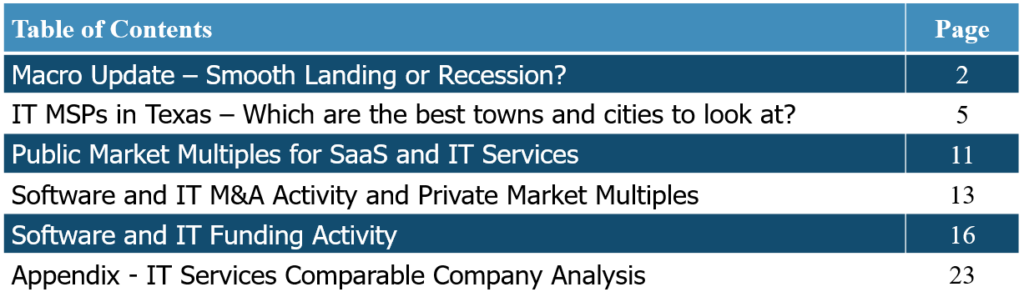
In this issue we continue to follow leading indicators and assess their effect on M&A, explore acquisition opportunities in Tier 1 and Tier cities in Texas and which are the best towns and cities to look at, as well review current multiples and funding.

Excendio M&A Newsletter Table of Contents July 2024


Receive your copy of the July Newsletter by clicking here.

Excendio IT & Software Newsletter and Market Update

IT and Software M&A Market Update – May 2024

Excendio Advisors IT and Software M&A Market Update – May 2024

by Madhur Duggar, Excendio Advisors

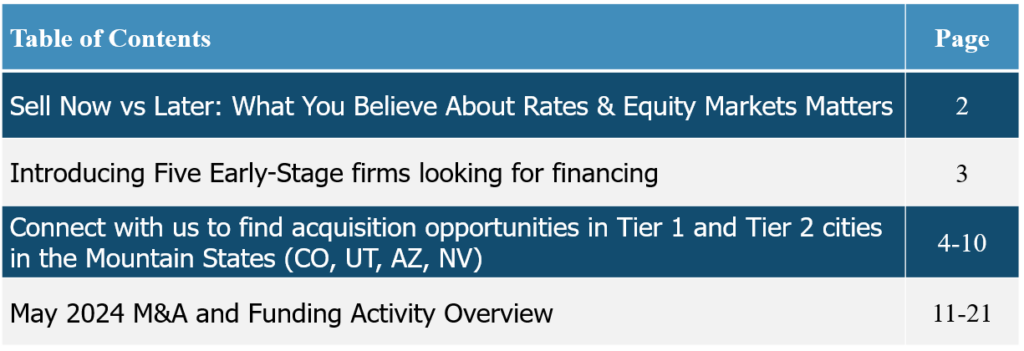
In this issue we explore the Sell Now vs Later concept and What You Believe About Rates & Equity Markets Matters, review early-stage firms looking for financing, and explore acquisition opportunities in Tier 1 and Tier 2 cities in the Mountain States

Excendio M&A Newsletter Table of Contents May 2024


Receive your copy of the May 2024 Newsletter by clicking here.

Excendio IT & Software Newsletter and Market Update

IT and Software M&A Market Update – April 2024

Excendio Advisors IT and Software M&A Market Update – April 2024

by Madhur Duggar, Excendio Advisors

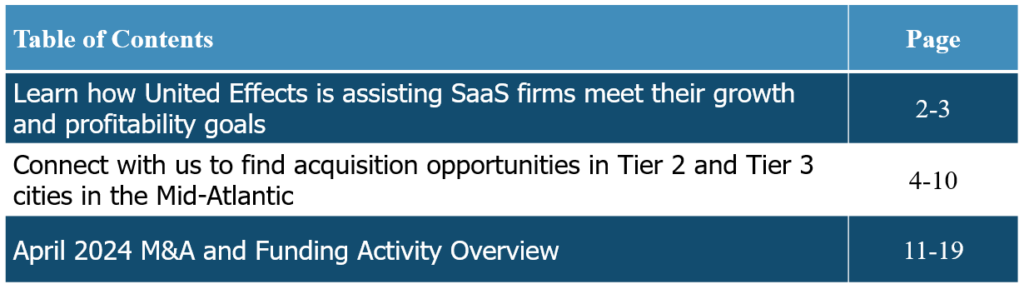
In this issue we learn how SaaS firms meet their growth and profitability goals, analyze acquisition opportunities in Tier 2 and Tier 3 cities in the Mid-Atlantic, as well as review April 2024 M&A and funding activity.

Excendio M&A Newsletter Table of Contents April 2024


Receive your copy of the April 2024 Newsletter by clicking here.

The Differences Between a Strategic and a Financial Buyer

[et_pb_section fb_built=”1″ admin_label=”section” _builder_version=”4.16″ global_colors_info=”{}”][et_pb_row admin_label=”row” _builder_version=”4.16″ background_size=”initial” background_position=”top_left” background_repeat=”repeat” global_colors_info=”{}”][et_pb_column type=”4_4″ _builder_version=”4.16″ custom_padding=”|||” global_colors_info=”{}” custom_padding__hover=”|||”][et_pb_text admin_label=”Text” _builder_version=”4.27.4″ background_size=”initial” background_position=”top_left” background_repeat=”repeat” hover_enabled=”0″ global_colors_info=”{}” sticky_enabled=”0″]

Excendio Advisor’s Managing Director, Cristian Anastasiu, explains the differences between strategic and financial buyers for M&A transactions.

[/et_pb_text][/et_pb_column][/et_pb_row][/et_pb_section]

Cristian Anastasiu on How to Prepare for an M&A Transaction

[et_pb_section fb_built=”1″ _builder_version=”4.16″ custom_padding=”||42px|||” global_colors_info=”{}”][et_pb_row _builder_version=”4.17.4″ background_size=”initial” background_position=”top_left” background_repeat=”repeat” min_height=”108.8px” custom_margin=”|auto|5px|auto||” global_colors_info=”{}”][et_pb_column type=”4_4″ _builder_version=”4.16″ custom_padding=”|||” global_colors_info=”{}” custom_padding__hover=”|||”][et_pb_text admin_label=”Text” _builder_version=”4.17.4″ background_size=”initial” background_position=”top_left” background_repeat=”repeat” min_height=”30.8px” custom_margin=”||19px|||” global_colors_info=”{}”]

Excendio Advisor’s Managing Director, Cristian Anastasiu, explains how to prepare for an M&A transaction.

[/et_pb_text][et_pb_code _builder_version=”4.17.4″ _module_preset=”default” custom_margin=”3px||||false|false” custom_padding=”0px||||false|false” global_colors_info=”{}”][/et_pb_code][/et_pb_column][/et_pb_row][/et_pb_section]

Capital to Covenants: Common Deal Points in IT Transactions

[et_pb_section fb_built=”1″ admin_label=”section” _builder_version=”4.16″ custom_margin=”0px||||false|false” custom_padding=”0px||||false|false” global_colors_info=”{}”][et_pb_row admin_label=”row” _builder_version=”4.16″ background_size=”initial” background_position=”top_left” background_repeat=”repeat” width=”100%” custom_margin=”0px||||false|false” custom_padding=”0px||||false|false” global_colors_info=”{}”][et_pb_column type=”4_4″ _builder_version=”4.16″ custom_padding=”|||” global_colors_info=”{}” custom_padding__hover=”|||”][et_pb_text admin_label=”Text” _builder_version=”4.27.4″ background_size=”initial” background_position=”top_left” background_repeat=”repeat” min_height=”180.2px” custom_margin=”0px||||false|false” custom_padding=”0px||||false|false” hover_enabled=”0″ global_colors_info=”{}” sticky_enabled=”0″]

Capital to Covenants: Common Deal Points in IT Transactions

By Cristian Anastasiu and Michael Schwerdtfeger

A while back Cristian Anastasiu, Managing Partner at Excendio Advisors, had the opportunity to co-write a series of M&A articles published by Channel Futures with Michael Schwerdtfeger.   One of the articles in that series discussed a number of deal terms that continue to bewilder newcomers to the M&A process: stock vs asset sales, working capital, and deal documents.   This short read will help clarify the readers understanding of these essential elements of M&A.

Over the past few months, we’ve taken a look at ongoing M&A activities in the IT services sector and the reasons for the current consolidation wave. We’ve also talked about how these companies are transforming to reduce risk and drive value to investors, an investor’s perspective on IT as a service, plus three steps to increase the value of your company, if and when you get ready to participate in the wave.

In the final segments of our series, we’ve shifted to the key transaction elements. Last month we discussed purchase price and terms; this month we will review other key deal terms that you might encounter.

Stock vs. Asset

From a legal and tax perspective, there are two types of M&A transactions: asset sales and stock sales. The key differences between the two are how legal liabilities are treated and how the proceeds and future company are taxed.

In terms of legal liabilities, in a stock transaction, the buyer inherits unknown liabilities, such as potential future lawsuits by former employees or clients. In comparison, in an asset transaction, the buyer usually explicitly declines to purchase any unknown liabilities and leaves those responsibilities with the seller. Consequently, buyers tend to prefer asset sales.

Asset sales are also beneficial to buyers from a tax perspective. In an asset sale, the buyer can usually depreciate the purchase price compared with a stock sale, where the buyer doesn’t get that tax benefit. From a seller’s perspective, in a stock transaction, the proceeds are generally taxed at the capital gains rate, while in an asset deal, the proceeds could be taxed at a rate as high as the income tax. Additionally, if the seller is a corporation that has not made a subchapter S election, it is possible that the proceeds of the sale will be subject to two layers of taxation.

Therefore, it’s no surprise that buyers prefer an asset transaction while sellers prefer a stock structure.

Fortunately, even where an asset sale is chosen, steps can be taken to limit the tax hit. If the seller is organized as a limited liability company (LLC) or has made a subchapter S election, in the case of “asset light” companies such as IT services companies, most if not all of the proceeds can be characterized in a way that will allow primarily capital gains tax treatment for the seller. Even for a C corporation, there are structures that can lead to a significant tax reduction for the seller without being detrimental to the buyer. Having both parties’ tax advisors talk directly can optimize the structure as a win-win for both sides.

So what can a seller do to persuade the buyer to accept a stock transaction?

For one, a buyer will be more open to a stock deal if the perception and expectation of any hidden liabilities is minimized or eliminated. To that end, it is very important for the seller to be transparent and follow a “bad news first” approach from the very beginning, with no surprises throughout the process. Making a great first impression and then consistently confirming it will set the tone for future negotiations and positively impact the terms the seller can negotiate. One buyer shared with us that they have three versions of a purchase agreement, and they decide which one to use in a given deal depending on how the initial due diligence went and their perception of how transparent and forthcoming the seller is: from a “light,” friendly version, with reduced indemnification and reps and warranties requirements, to a very detailed one including significant and broad indemnifications and stronger language.

One other reason a buyer may prefer a stock transaction is that, in a stock deal, most if not all agreements (with clients, vendors, employees) are more easily transferred, making the post-acquisition integration process much smoother. We’ve seen this occur in transactions where there are crucial third-party agreements (or governmental approvals) that would be difficult to renegotiate or otherwise assign.

Working Capital

An offer is not complete if it does not specify the amount of working capital the seller must deliver at closing. This is one of the most misunderstood components — and sources of friction — during the purchase agreement negotiation and due diligence, if it has not been discussed early on, as part of the Letter of Intent.

There is general agreement that an IT services company will “come with” enough working capital — calculated on a cash free, debt free basis — such that the buyer will not have to bring additional money to run the company post-closing. This is sometimes in conflict with an owner’s expectation that he should be able to keep the “equity” in the company at closing, where the seller believes that the working capital is his own.

In most cases, the equity is the same as the working capital a buyer needs to run the company. At the end of the day, this becomes an academic, but sometimes emotional, argument. The bottom line is that an offer needs to specify how the balance sheet, including working capital, will be treated at closing.

However, there are a few exceptions that a seller should consider before agreeing to deliver the full amount of required working capital: If the company is growing and as a result requires more working capital, but the valuation was based on past performance, shouldn’t the working capital be adjusted to those lower revenues? Or if the cash at closing is less than 70 percent or even 50 percent of total consideration, shouldn’t the delivered working capital reflect that percentage?

IT services companies with recurring revenues and multi-year contracts will have a significant deferred revenue account on the balance sheet. Should the full amount be considered a liability when determining the target working capital at closing?

Finally, it is important for the buyer and seller to agree on how working capital will be determined and how the adjustment at closing will be calculated (for example, based on GAAP or on past practices). Lack of clarity can lead to disputes.

Deal Documents

Eventually, there will come a time in the transaction when the attorneys talk directly and work out all the details of the deal documents. But, since many of the items that were discussed during negotiations are business and economic rather than legal, the principals and the intermediaries should be directly and actively involved in this process.

Regardless of whether the transaction is an asset sale or stock sale, the main deal document is the Purchase Agreement, which will include definitions, representations and warranties, schedules, indemnifications, conditions to closing and covenants. The purchase agreement will also most likely be supplemented by other documents such as employment agreements, notes, credit documents, equity agreements and similar forms.

  • Definitions: The definitions section is one of the most important because if done right and comprehensively it can help reduce or even eliminate conflicts post-closing. The definitions, including how EBITDA, gross margin, working capital, and earn-outs will be calculated, are very specific to each deal and require the active involvement of both the buyer and the seller, as well as their counsel.
  • Representations, warranties and indemnities: This section will include representations about virtually every aspect of the business and is intended to be a risk sharing mechanism primarily protecting the buyer. Indemnities address what happens if liabilities occur, and who, how much and for how long should be held accountable.
  • Conditions to closing: This is a list of conditions that must be met by either party before closing the transaction. In the case of IT services companies, the most significant component will be consents from customers and partners, if the respective agreements so require. Also, the letter of intent should disclose what approvals the buyer will need to close (for example, financing).

Covenants: Covenants will include agreements of the parties to do certain things at and after closing. These provisions typically address items such as post-closing employment, non-compete and non-solicitation by the seller and stockholder agreements.

[/et_pb_text][/et_pb_column][/et_pb_row][/et_pb_section]

Questions to consider

Buying a Business? Questions to Consider

By Bill Vinck, Excendio Advisors

Buying a Business? Questions to Consider

Background

Buying a business can be a risky, complicated, and expensive process. It’s in the prospective buyer’s best interest to be well prepared when approaching a planned acquisition. Here are six key questions to keep in mind:

1.    What are you trying to accomplish in buying a business?

Some buyers are buying themselves a job. The current owner is active in the business and may pay themselves a reasonable salary. The buyer may believe they can replace the owner themselves while paying themselves the same salary. In effect, the new owner is buying a type of annuity. Is that the plan or is this an investment with the owner (or his replacement) remaining in place and you the buyer an investor receiving some type of dividend? Knowing precisely what you are trying to accomplish is key.

2.    How do you plan to finance the acquisition?

There is, of course, the cost of the business, the terms of which must be negotiated. There will be the need for cash to close and perhaps payments over time. Almost immediately, a buyer will incur additional cash obligations: legal fees, accounting fees, and business advisory fees. The buyer must have a budget for these. Do you have a budget? Do you have ready cash? How thoroughly have you planned the acquisition and related costs?

If you require a loan, your financials as well as the seller’s will be required. Are your financials in good shape? Are the seller’s? Have you financial institutional relations that will speed the loan approval process? What if they say no?

3.    What is your view of timing for a transaction?

You should have a detailed project plan to cover all eventualities. Some tasks are under your control; some are not.

Loan applications and reviews can take weeks and deals may be competitive. Prolonged time periods reduce the likelihood of a happy ending.

Lengthy time periods increase stress all around. Business buying is a time-consuming process. Do you have the time to dedicate to it? Does your team?

4.    What’s your “Deal Model”?

A buyer should also have a “deal model” in mind. What are the terms and conditions acceptable to you, the buyer. Will you require the owner to remain active (and be compensated) for a month? Six months? A year? If you agree to annual payments, what will be the source of the funds to make these payments? Will you require an earn-out? If you’re getting a loan, your provider will likely insist on certain terms.

5.    What value beyond the purchase do you bring to the business?

This can be a humbling question to answer. The current owner has the business configured to deliver the exact results they are getting.

Can you do as well? Or better? Does your deal model require an improvement in performance to make sense?

If you feel you can do better, what is the plan and budget to accomplish this improvement? What if it fails?

6.    What is your due diligence process?

The seller will make certain representations about business performance. Due diligence is the process that reviews these representations.

This includes all financial, operational, legal, and human resources data as a minimum.

Due diligence is the detailed basis for an acquisition go-no-go decision and the area where acquisitions can fail.

Do you have a process in place? Are you able to conduct it yourself? Are you confident in it? Consider having an experienced third party conduct this review on your behalf as much depends upon it.

Conclusion

These six questions are a great start when buying a business. One should create a project plan and budget. Once completed, it’s best to have a team prepared to support you in this process. The team could include you, your accountant, attorney, banker, and a business advisor to help you through the process. Tread carefully as mistakes are expensive.

Should ERP Integrators Acquire AI capability?

Should ERP Integrators Acquire AI capability?

By, Anthony Kelly, Excendio Advisors

ERP integrators are acquiring Artificial Intelligence (AI) capabilities at an increasing rate to fulfill client requirements in the implementation arena.  AI is now becoming standard requirement for many ERP systems.  Gaining this ability to enhance ERP systems is an increasing skill requirement for integrators.

AI has the potential to significantly impact ERP systems in various ways. ERP systems include all functional and managerial areas of a company. Overall, AI is having a positive impact on ERP systems by helping businesses to automate tasks, improve decision-making, and streamline operations. This can lead to improved efficiency, reduced costs, and increased profitability.

Moving forward it is my opinion that AI skills are a must have for ERP integrators.  To have these skills the integrator can acquire an AI company, train current employees, or hire the skills to remain relevant.  Understand there is a severe shortage of AI skilled talent.

According to a 2023 survey by McKinsey & Company, 50% of companies have adopted AI in at least one function. This is up from 20% in 2017.  Some of the industries with the highest rates of AI adoption include:

  • Financial services
  • Healthcare
  • Retail
  • Manufacturing
  • Technology

Listed are some examples of Large ERP integrators that have acquired AI capabilities:

  • Accenture acquired AI startup Evrythng in 2019 to help its customers implement AI-powered solutions for product traceability and supply chain management.
  • IBM acquired AI startup Watsons in 2015 to add AI capabilities to its ERP software Watson Supply Chain Intelligence.
  • KPMG acquired AI startup CognitiveScale in 2018 to help its customers implement AI-powered solutions for financial forecasting and risk management.
  • Deloitte acquired AI startup Rubikloud in 2019 to help its customers implement AI-powered solutions for customer experience management and fraud detection.
  • Microsoft’s acquisition of Nuance Communications for $19.7 billion in 2021
  • Salesforce’s acquisition of Slack for $27.7 billion in 2020
  • Google’s acquisition of Fitbit for $2.1 billion in 2019
  • Nvidia’s acquisition of Mellanox Technologies for $6.9 billion in 2020
  • Intel’s acquisition of Habana Labs for $2 billion in 2019

ERP integrators of all sizes are increasingly acquiring AI capabilities to provide their customers with more comprehensive and value-added services. AI can be used to improve ERP systems for all industries and sizes in several ways, including:

Employee Training

AI is making employee training more personalized, adaptive, engaging, and effective. This can lead to several benefits for businesses, including improved employee performance, productivity, and satisfaction.

AI can be used to create VR and AR training classes that are more enveloping and interactive than traditional training approaches. This can be especially effective for training employees on intricate tasks or procedures.

Some specific examples of how AI is being used in employee training today:

  • Salesforce uses AI to create personalized learning paths for its sales reps, based on their individual goals and the products they sell.
  • Walmart uses AI to train its employees on new safety procedures and store policies.
  • Delta Air Lines uses VR to train its pilots on new aircraft and flight procedures.
  • Amazon: Amazon uses AI to gamify its training experiences. For example, Amazon has a leaderboard that tracks employees’ progress on training modules. Employees who complete training modules and achieve certain learning goals are awarded badges.
  • Google: Google uses AI to create microlearning modules for its employees. The microlearning modules are short, focused, and engaging, and they cover a wide range of topics, such as coding, marketing, and project management.
  • Netflix: Netflix uses AI to create personalized learning paths for its employees. AI adapts the learning paths based on each employee’s progress and performance.

Improved Data Analysis:

AI can enhance data analysis capabilities within ERP systems. Machine learning algorithms can process and analyze vast amounts of data, providing deeper insights into an organization’s operations, performance, and trends. This can help in making data-driven decisions.  Big data and AI have a synergistic relationship. Big data analytics leverages AI for better data analysis. In turn, AI requires a massive scale of data to learn and improve decision-making processes.

Predictive Analytics:

AI-driven predictive analytics can help ERP systems forecast future trends, demand, and potential issues. This can be particularly valuable in supply chain management, inventory optimization, and demand forecasting.   

Improvements in technology have dramatically changed what enterprise analytics can do, but predictive and descriptive analytics still require time, expertise, and lots of data.  They often produce only narrow insights. However, AI is making it possible for analytics to automatically incorporate and process important context from a broad array of sources — many of which would have previously required analysts to navigate silos and poorly maintained data bases. Google applications can tell you based on your location, calendar, and traffic information that it’s time to leave for the airport if you want to catch your flight.  Companies can increasingly take advantage of contextual information in their enterprise systems.

Automation:

AI can automate routine and repetitive tasks within ERP systems. For example, AI-powered chatbots can handle customer inquiries, and robotic process automation (RPA) can streamline data entry and invoice processing.

Artificial intelligence holds revolutionizing potential across all industries. AI can be divided into two categories: automation and augmentation. By automating, we can eliminate the need for human labor, and by augmenting, we can use AI to enhance the intelligence and performance of human beings.

Natural Language Processing (NLP):

NLP capabilities can make it easier for users to interact with ERP systems using natural language queries. This can simplify data retrieval and reporting processes.  Natural Language Processing (NLP) makes it possible for computers to understand the human language. Behind the scenes, NLP analyzes the structure of sentences and the meaning of words, then uses algorithms to extract meaning and deliver outputs. In other words, it makes sense of human language so that it can automatically perform tasks.

Probably, the most popular examples of NLP in action are virtual assistants, like Google Assist, Siri, and Alexa. NLP understands written and spoken text like “Siri, where is the nearest gas station?” and transforms it into numbers, making it easy for machines to understand.  In the hospitality industry, voice kiosks allow for ordering and payment based on voice command. Another well-known application of NLP is chatbots. They help support teams solve issues by understanding common language requests and responding automatically.  Reducing the amount of time needed from human intervention.

Fraud Detection:

AI can enhance fraud detection capabilities within ERP systems by identifying unusual patterns and anomalies in financial transactions and procurement processes.

Before AI, fraud prevention systems would rely on rules alone, which are great at analyzing past fraud patterns. By combining supervised learning algorithms trained on historical data with unsupervised learning, digital businesses gain a greater level of understanding and clarity about the risk of customers’ behaviors. Decisions to accept or reject payment, stop fraudulent activity to limit chargebacks and reduce risk are all possible.

Rule engines and predictive analytics can scale only so far in uncovering fraud.  Businesses will often revert to tougher standards for transaction approvals if they have been burned by fraud. The result is a bad customer experience. By having an AI-based fraud prevention system do the work of evaluating historical data and anomalies, customer experiences can stay more positive, and the more sophisticated fraud attacks can be avoided.

Maintenance and Asset Management:

AI-powered predictive maintenance can be integrated into ERP systems to monitor the condition of machinery and equipment, helping organizations schedule maintenance tasks more efficiently and reduce downtime.

Enterprise asset management (EAM) is a combination of software, systems and services used to maintain and control operational assets and equipment. The aim is to optimize the quality and utilization of assets throughout their lifecycle, increase productive uptime and reduce operational costs.  Enterprise asset management involves work management, asset maintenance, planning and scheduling, supply chain management and environmental, health and safety (EHS) initiatives.

Supply Chain Optimization:

AI can optimize supply chain management by analyzing data from various sources to improve inventory management, supplier selection, and logistics planning.  Artificial intelligence can take over much of the difficult work of supply chain management and optimization, freeing employees for other things and improving efficiency.

AI systems are fast, efficient, and tireless, making it possible to improve efficiency in a supply chain, reduce the need for human work, improve safety, and cut costs.

Cost Reduction:

Through automation and optimization, AI can help organizations reduce operational costs and improve overall efficiency, which is a significant benefit of ERP systems.

Another way in which AI can be implemented in your organization to cut costs is by reducing repetitive tasks. This can help improve worker productivity and reduce waste. What AI is best at are the tasks that humans find boring and repetitive. When you can implement AI to take on those tasks, you can help your workers get back to doing the work that only humans can do.

Organizations track procurement costs and losses. Yet, that data sits unused after the month’s or year’s end. The data can be fed into a machine learning algorithm which can look for patterns and make suggestions as to how your business can become more efficient.  By using your data, you can start to predict changes you need to make before they become issues and get automated insights. Machine learning can help you get a better understanding and save money by category, supplier, and business unit.

Enhance Reporting and Insights:

AI can generate advanced reports and provide executives with real-time insights into business performance, helping them make informed decisions.  AI-powered reporting tools are revolutionizing the way businesses analyze and interpret data. AI helps identify patterns, trends, and anomalies in data that might be impossible to detect for humans. AI reporting tools offer insights that employees can use to make data-driven decisions promptly.

Continuous Learning:

AI can enable ERP systems to continuously learn and adapt to changing business conditions and requirements, ensuring that they remain relevant and effective over time. To cope with real-world dynamics, an intelligent agent needs to incrementally acquire, update, accumulate, and exploit knowledge throughout its lifetime. This ability, known as continual learning, provides a foundation for AI systems to develop themselves adaptively.

The important issues of continuous learning are:

  • Improved accuracy and performance: Continuous learning allows AI systems to improve their accuracy and performance over time as they are exposed to more data and learn new things. This is important for AI systems that are used in critical applications such as self-driving cars and medical diagnosis.
  • Adaptability to change: Continuous learning allows AI systems to adapt to changes in their environment and data distribution. This is important for AI systems that are used in real-world applications, where data is constantly changing and evolving.
  • Reduced need for human intervention: Continuous learning can reduce the need for human intervention to keep AI systems up to date. This is important for AI systems that are deployed in large-scale or distributed environments.

Integration and Emerging Technologies:

AI can be integrated with other emerging technologies such as the Internet of Things (IoT) and blockchain to create more robust and intelligent ERP systems.

Smart technologies like AI and machine learning will be at the core of ERP. These technologies can complement ERP functions by managing and integrating diverse applications and then using the data to support decision making. This allows the ERP system to optimize workflows, shorten lead times, and reduce errors. AI-based tools can also use system-generated data to initiate more informed decision-making by helping to identify red flags before business is affected.

AI is also helping to make ERP systems more accessible and affordable for businesses of all sizes.  While AI holds great promise for enhancing ERP systems, it’s important for organizations to carefully plan and implement these technologies to ensure they align with their specific business goals and processes. Additionally, considerations around data privacy, security, employee acceptance and ethical AI usage should be considered when integrating AI into ERP systems.

Overall, AI is expected to make ERP systems more intelligent, efficient, and user-friendly.  Companies in all sectors are looking to invest in AI with their ERP system to stay ahead of the competition.

References:

-Forbes

-Gartner

M&A: A Variation on a Theme

By Bill Vinck, Excendio Advisors

M&A: A Variation on a Theme or (Sometimes one needs to change the musical score)

Background:

One typically acquires a firm for several reasons. The short list of reasons would include the acquired firm’s EBITDA and the related growth trajectory. Access to clients, markets, and talented staff are also high on the list of sought after attributes.  The acquisition is often felt to combine the operational and financial strength of the acquirer to the advantage of the acquired firm. This model motivates a lot of M&A activity.

There is a related approach which goes beyond the common variety and builds upon it. This approach can be called a Variation on a Common Theme.  This article lays out an overview of the variation concept.

What Is this Variation?

It is a deliberate implementation of the basic M&A theme mentioned above with one interesting new dimension. The acquired firm or firms is/are additionally seen as having certain characteristics that are particularly and uniquely interesting to the prospective buyer. These characteristics, the variations, are part of the business model of the acquired firm. They are part of the operational DNA of the firm. The buyer, however, sees them as more than this and this vision is what really motivates the acquisition.

An Example:

Imagine an acquisition strategy in which, say, three firms are acquired and integrated into the acquirer’s platform as appropriate.

Each acquired firm has a particular characteristic, a variation, of particular interest to the “vision” of the acquirer. In fact, the existence of this “variation” played a major role in the acquirer’s pre-acquisition review. Due diligence verified that the characteristic existed, functioned as thought, and would serve the acquirer’s post-acquisition need.

The acquired firms continue to operate as before and are managed in a “Berkshire Hathaway” fashion. That is, management expertise is shared, capital allocation decisions are facilitated by the parent, but things continue much as before…with one major exception.

The Variation on a Theme Exception:

As we saw, the acquired firms each had a characteristic perhaps unremarkable when viewed in the context of its’ place in the parent firm but when deliberately combined with the certain unique characteristics acquired from the other firms a completely new and different suite of capabilities resulted from this combination. This result was the design intent in the first place.  The construction of this suite of capabilities was a major motivation for the acquisitions. It was the variation on a theme. That is, the acquirer had a particular acquisition design thesis in mind and by acquiring the three firms in this example they began the implementation of that thesis.

A Case Study:

Tapestry Partners, A Private Equity Firm

Meet the Team: Vera, Nora P and Beckham

The team met in school and began a conversation about interesting things to do professionally. They were intrigued by the Private Equity model and decided to pursue it but as a variation on a theme.

Background

Tapestry Partners is the acquiring firm, and it has several operating partners. They have varied but complementary backgrounds. The partnership skill set was very deliberately designed to support the Tapestry Investment Thesis. They are self-described as “Hands-On” Partners. This means they each have significant background and interest in several complementary areas:

  • Business process improvement (BPI): Nora P is the partner particularly interested in BPI related technology such as AI and Quantum Security. She also sings with a jazz group but that’s more of a hobby. She has experience in data enabled BPI optimization. She realizes that not all processes are created equally. She’s particularly interested in customer facing processes with actual or potential digital transformation configurations. She is experienced in the review, analysis, measurement, and measured improvements in customer facing business processes and is well-versed in data mining and creating customer data-based AI algorithms.
  • Silicon Valley Tools (SVT): Beckham is a partner who has done work very detailed work in AI, Machine Learning, Speech Recognition, and Data Analytics, all aka “Silicon Valley Tools”. He knows such tools can be valuably deployed where reasonable in BPI and has deployed them himself in prior assignments. His role is to use his particular expertise to create the “Variation” technical architecture.
  • Integrated Digital Operations Design (IDOD): Vera is the partner who works intimately with the portfolio firms. She is an operating executive with a specific charter. Vera’s interest is focused entirely on influencing and directing specific elements of the operation, i.e., BPI and related data management and SVT technology deployment. Her focus is the design and implementation of Tapestry Partner’s Investment Thesis. She is the business architect with two principal mandates: Create a unique digital business architecture and build the business plan to launch it.

Key Point: The Tapestry Team is not principally interested in day-to-day operational management of the acquired firms. These firms are operationally sound and have a management team in place executing the firm’s growth plan. The idea is for the firms to continue operations as planned while the team abstracts the variations as the key architectural building blocks of a completely new entity.

The Variation on a Theme Investment Thesis is a Digital Transformation Thesis. The DTT is simply a digital business idea that can be implemented by combining discrete and transportable components of the acquired businesses.  Tapestry Partners is ever alert to such capabilities as they review candidates for acquisition. The design of the component integration is key. That’s where the team comes in.

Whereas generally many PE partners have strong financial backgrounds, our Tapestry team is as strong in these specific technologies. They are, for obvious reasons, discrete in their disclosure of these plans as they are highly contingent, prone to delay, and could affect valuation deliberations. The design, construction, launch and operation of such a business is highly risky and this risk must be managed. But Tapestry Partners has built itself around this very idea and is prepared to manage the risk.

The Tapestry DTT has several components: Customers (and their behavior), Products (and their characteristics), and Markets (and their niches). Tapestry sees itself as a niche market maker and they define a niche as the “Financial Point of Intersection between Customers and Products under Mutually Advantageous Circumstances” or (FPoCbCaMuMAC).

How to begin?

Phase One: This could be the start of something!

  • Acquisition in the Business Services segment.
  • EBITDA of $2.0M is the minimum.
  • Data heavy, capital light business operation.
  • Current management remains in place while Tapestry works on the M&A Variation topic, i.e. the Tapestry IT Investment Thesis.
  • Geographically Agnostic.
  • Control 100%.
  • Indefinite holding period.

 Phase Two: This could be very interesting!

The partner’s “Hands On” approach mentioned above lays the groundwork, as an example, for a potential meta-data strategy related to but independent of and in addition to the basic acquisition strategy. This strategy could, for example, combine data from the acquired firms into data sets that enable digital transformation scenarios unimaginable without the completion of the M&A phase one projects and combining them with Tapestry Partners unique vision and skill sets.

Conclusion and a Lesson

Serendipitously, Tapestry Partners found an M&A advisor and, after detailed conversations with each partner, the advisor asked somewhat boldly if the variation on a theme approach was, in fact, the real goal. Somewhat taken aback, without confirming or denying, the partners asked the advisor to propose a plan. He did.

What happened then? Sorry. It’s confidential.  But a lesson here is that some things require some finesse and swag (F&S) and if you find an advisor with F&S, wonderful things can happen. But be careful, the sad truth is that not everyone has F&S.

Master Class: M&A as a Symphony Orchestra

Master Class: M&A as a Symphony Orchestra

By Bill Vinck, Excendio Advisors

Follow the Conductor Closely!

Background:

In the last 40 years, Brad Jacobs has done almost 500 deals while building several billion-dollar businesses. He built United Rentals, an industrial equipment rental company and United Waste Systems, a garbage collection company, to name a few. You might say that he was a conductor of an M&A symphony orchestra.

A review of his approach is instructive. One might call it a master class in M&A. In this article, we’ll review some of the major lessons that can be gleaned from this background.

Lesson #1:

Be painfully clear on the strategic rationale for the acquisition.

Example: United Waste

Strategic Rationale: There was significant fragmentation in the waste collection market-place. Such fragmentation presents an opportunity for the focused acquirer in terms of target density and scale. The key was to identify an approach that would allow the nimble acquirer to build commanding market share.

Approach: Avoid major markets. Identify tertiary markets and begin the campaign with landfill acquisitions in those areas.

United Waste was a roll-up. The strategy was to roll-up collection companies in these tertiary markets. But rather than immediately approaching collection companies, they focused on identifying and buying landfill capacity. Recognizing that scale is a critical variable in the waste business, they focused on geographic areas where they could quickly achieve major market share.

Once that landfill footprint was established, focus changed to reviewing the collection companies that used that landfill and begin the acquisition process from a position of relative market strength.

Result: The strategy worked. They experienced a 55% CAGR on both earnings and stock price.

Example: United Rentals

Strategic Rationale: United Rentals was designed as a roll-up first and a roll-out second based on the understanding that the ROIC on the roll-out is greater but unattainable without a successful roll-up.

Approach: The roll-up was the acquisition of about 250 industrial equipment rental companies. In some weeks, as many as 3 acquisitions were competed. The roll-up was a financial success, but UR realized that what they meant to acquire and did acquire was a growable footprint. Those 250 companies were that footprint. Once acquired and integrated, the roll-out from the new acquisitions began and it was more successful on a ROIC basis than the original roll-up.

Result: United Rentals in this period outperformed the S&P 500 by a factor of 2.

Lesson #2:

M&A is a team sport and multiple team activities must be coordinated.

The major cogs in the M&A machine included location and candidate company reviews, contract negotiation, business process planning and integration, cultural integration, technology integration, back-office integration, and marketing and sales alignment. Each of these “cogs” is supported by a dedicated team and by a defined process.

It was clearly understood that early movement to common systems was central to success.

Each team must move quickly and cleanly as the other teams are counting on them. There’s no room for a broken “cog” in this machine.

Lesson #3:

A successful acquisition requires a deal business model (DBM).

The DBM is a set of answers to a series of internal and external questions such as:

What impact will this acquisition have on:

  • Improving the service we provide for customers?
  • Improving the cost structure of our firm and providing the basis for improved margins?
  • Improving our ability to offer more product capabilities?

The details of the DBM will vary from transaction to transaction. The key, however, is that these answers are developed in depth and avoid the mind-numbing cliches typically heard in the justification of an acquisition. “Synergy” is a perennial favorite in this arena. Those who understand DBM and take it seriously further understand that detailed, data driven answers to the above questions will define success or failure. They become the principles by which the entire operation is managed.

Conclusion:

The above approach was successful over hundreds of acquisitions completed over many years. The lessons provided, however, are useful to anyone active in the M&A world.


How to Scale your Business for Greater M&A Value

How to Scale your Business for Greater M&A Value

By, Anthony Kelly, Excendio Advisors

Scaling a business requires careful planning and execution.  Scaling a business is not the same as growing your business.

  • Growth can be done in a fashion that increases or destroysbusiness value.  Scaling however is a “Value Enhancing approach to Growth” so it’s growth without any value destruction.
  • Scaling means you are able to support an increase in sales, work and output in a cost-effective manner.  Your company can handle growth without suffering in other areas such as employee turnover due to increased workloads and missed deadlines.
  • Scaling is an integrated activity or a “team sport” that needs all hands. Any CFO can reduce price, generate revenue growth while wrecking margins and destroying value.
  • Scaling is not the same as running a business. Rather it is a specialty that requires some finesse which in turn can be provided by selected 3rd party advisors.

There are several reasons to scale your business. They include:

  • Increased profitability through increased revenue and economies of scale.
  • To give you a competitive edge by allowing you to dominate your market segment.
  • Incents Innovation and continuous development of products, services, and processes. This focus on innovation can lead to new opportunities, increased market relevance, and enhanced customer satisfaction.
  • Provides access to additional resources such as funding, talent, technology, and partnerships.
  • Allows diversification of your revenue streams without reliance on a single market or product.
  • Makes your business more attractive to investors, enabling you to secure funding for expansion and future development.
  • Allows you to attract top talent as your team grows, fostering innovation and expertise in your organization.

Here are some steps to consider when scaling your business and increasing the overall value of your organization:

  1. Evaluate your current business model: Assess your existing business model to determine its scalability potential. Look for areas where you can increase efficiency, optimize processes, and identify potential bottlenecks that may hinder growth. Make sure all employees understand the purpose and effect the process will have on them.
  2. Set clear and realistic goals: Define your scaling goals. Determine the key performance indicators (KPIs) that will help you track your progress and measure success. This could include metrics like revenue growth, customer acquisition, market share, or expansion into new markets. Start slowly to ensure your people and platform are prepared for rapid growth.
  3. Develop a scalable infrastructure: Ensure that your business infrastructure can support growth. This may involve upgrading your technology systems, improving your operational processes, and implementing scalable solutions such as cloud-based software or automation tools. Make sure your company has proper training on the systems.
  4. Secure adequate funding: Scaling often requires additional capital to invest in areas like marketing, hiring, infrastructure, and inventory. Explore different funding options such as loans, venture capital, angel investors, crowdfunding, or bootstrapping. Prepare a comprehensive business plan and financial projections to attract potential investors.
  5. Expand your customer base: Focus on acquiring new customers while retaining existing ones. A major key in scalability is customer and employee retention. Develop a targeted marketing strategy to reach a wider audience, leveraging both online and offline channels. Utilize digital marketing techniques like search engine optimization (SEO), social media marketing, content marketing, and paid advertising to increase brand visibility and attract new customers.  Attend your target market conferences for visibility.  Secure speaking engagements at events to introduce your company and show thought leadership.
  6. Hire and develop a capable team: As your business grows, you’ll need to expand your team to meet increasing demands. Hire employees who align with your company culture, possess the required skills, and have the ability to adapt to a changing environment. Provide training and development opportunities to empower your team and ensure they are equipped to handle new challenges. As you hire bottom up you will also need to hire capable management to manage the growth in people and business.
  7. Streamline processes and delegate tasks: Identify inefficiencies and streamline your operations to improve productivity. Delegate responsibilities to capable team members, empowering them to take ownership and contribute to the growth of the business. Implement effective project management tools and systems to track progress and ensure smooth coordination among team members.
  8. Explore strategic partnerships: Seek partnerships with complementary businesses or suppliers to leverage their expertise, resources, and customer base. Collaboration can help expand your reach, reduce costs, and open new opportunities for growth. One area of expansion could be into Government markets. If you are a minority, woman owned or disabled veteran owned company, securing a relationship with government entities can be a long-term revenue and growth opportunity. Even without any of these certifications you can solicit business from the government to help secure contracts.
  9. Monitor and analyze data: Regularly track and analyze relevant data to gain insights into your business performance. Utilize analytics tools to measure the effectiveness of your marketing campaigns, track customer behavior, and make data-driven decisions. Continuously refine your strategies based on the information you gather.
  10. Maintain a focus on customer experience: Prioritize customer satisfaction and retention. Provide exceptional customer service, listen to feedback, and address any concerns promptly. Loyal and satisfied customers can become brand advocates and help drive organic growth through positive referrals.

Scaling a business requires careful planning, adaptability, and a willingness to take calculated risks. Regularly reassess your strategies, stay agile, and be prepared to make adjustments as you navigate the challenges and opportunities that come with scaling your business.

If you would like assistance in scaling your business for the highest valuation in the M&A arena, please contact me at Excendio Advisors.

References: Fortune Magazine

Surprise! Maxims & Misconceptions About Selling a Business

Surprise! Maxims & Misconceptions About Selling a Business

By Cristian Anastasiu, Excendio Advisors

For a vast majority of our clients, selling their business is a once in a lifetime event.

It comes as no surprise that over the years, many business owners develop a certain expectation about the M&A process whether by talking to friends who sold their business, listening to M&A advisors, participating in peer groups, participating in webinars, reading related literature, etc. Time and again, while advising clients on the sale of their business, we experience their surprise when many of those expectations are not met, and they come to discover their misconceptions.

Recently, we conducted a survey among IT business owners who sold their business in the last 20 years. Among the questions we asked were these: What was the biggest surprise you experienced during the process of selling your business? What was your biggest misconception? What would you have done differently, knowing what you know now?  Their answers validated what we have experienced leading our clients through the M&A process.

The following is a compilation of the answers we received with additional insights from our own experience working with clients over 20 years.

Surprises regarding the BUYER

  • Sellers are often surprised to learn how different each type of buyer is, be it strategic, financial, etc., in their approach, goals, transaction structures, etc. See also Differences between a Strategic and a Financial Buyer
  • Most sellers do not know the buyer at the beginning of the M&A process. In more than 95% of our transactions, the company that ended up acquiring our client’s company was not known to our client at the beginning of the process. For any lower middle market IT services company, there could be dozens, if not hundreds, of potential buyers.
  • Many business owners are surprised to learn that buyers look at their business differently than they do as owners and operators; sellers do not always understand the buyer’s motivation in acquiring their business; the reason a company is a good fit for a buyer is in some cases not obvious to the seller and the buyer might not be inclined to share it.


Surprises regarding the VALUATION

  • A very common misconception among business owners selling their business is the belief that they, the seller, gets to keep the working capital at closing. But unless explicitly negotiated otherwise, an offer for a business assumes that the business will be delivered with sufficient working capital at closing – see also M&A and Working Capital.
  • It is generally known and expected that buyers try to either avoid acquiring or discount the value of a company they are looking to acquire that has a high customer concentration. While this is certainly true for Private Equity buyers, who are very focused and driven by the financial aspects of a business, some strategic buyers are, under certain circumstances, prepared to pay a premium for a company deriving a significant portion of its revenues from one customer. This is especially true if that customer is, for example, a large, Fortune 100 enterprise. This would be a sign that the acquired company can handle large customers, they have a strong relationship, and opportunities exist for the buyer to cross sell.   Some buyers see customer concentration as a strength and opportunity, which comes as a pleasant surprise for many sellers.
  • The concept of “Adjustments” to EBITDA or “Owner Addbacks” is generally understood, but when it comes to determining the specifics, many business owners have surprises – some pleasant and some not. Probably the most common misconception is around “owner compensation”. Generally, buyers adjust the current owner compensation to reflect a market replacement salary for someone with the qualification and skill set to replace the owner, even if the owner continues with the business and is open to receiving a lower salary post-closing with the goal of increasing the adjustments and as a result the EBITDA and the valuation of the company.


Surprises regarding the M&A PROCESS

  • Many business owners find out that the M&A process is more complex than imagined, and often features twists and turns along the way; due diligence can be very time consuming, intense, and exhausting. What is not intuitive to sellers is that a robust due diligence process is also in the seller’s best interest and will later protect them, because it uncovers any potential discrepancies and unintended misrepresentations which are more difficult to resolve later.
  • However, due diligence is a two-way street and sellers should be prepared to conduct some buyer due diligence as needed and appropriate. Ask the buyer about prior successes and failures, lessons learned, referrals, etc.
  • Sellers have told us that they underestimated the value of the CIM (Confidential Information Memorandum) and company financials or that they initially had a different opinion regarding those documents’ structures and roles. Qualified, motivated, and active buyers review hundreds if not thousands of CIMs every year. Having well prepared documents signals to potential buyers not only a certain level of motivation and interest on the part of a seller, but also organizes and presents the information in a way that is meaningful to buyers and can result in higher valuations.


Surprises regarding the role and value of the M&A ADVISOR

  • Some business owners initially believe that they can save money if they are not working with an advisor but come to realize that an advisor can help them reduce legal, accounting, and other fees. An advisor can help increase the proceeds by running a competitive M&A process and allowing the business owner to stay focused on managing the business.
  • Some sellers believe that they can start the M&A process by themselves and later bring in an advisor, but the reality is that one can’t parachute an advisor into the middle of the deal, because each deal has its own history and cadence, and the participants must be involved from the beginning, every step of the way.
  • Some of the sellers who did not use an advisor shared that they mostly missed having someone on their side helping them to not second guess every decision.
  • Advisors bring the required experience and skill set necessary to effectively stage the disclosure of information to a potential buyer at the appropriate points of the transaction process.
  • In addition, an advisor can conduct a “limited” and very targeted M&A process and target the effort while maintaining confidentiality and keeping to a minimum the number of potential competitors receiving information.


Surprises regarding the role of the SELLER

Selling a business is very different from selling a service or a product, which our clients are experts in and have done successfully over many years. Business owners realize, sooner or later, that some of their selling skills and instincts from their “day job” do not fully translate or apply when selling their business.

  • Some sellers tend to oversell when meeting with buyers. For example, some business owners are trying to find a buyer’s “pain point”, a common sales technique, but many experienced buyers are very reserved about sharing their strategy, goals, and motivation. Sophisticated and experienced buyers don’t like to be “sold to” and become suspicious that the seller is overcompensating or not disclosing a certain fact or facts.
  • Telling a potential buyer “I am not ready to sell but I always listen to offers” or “I would sell for the right price” does not entice the buyer to make a better offer or motivate them to engage with a seller to start with. Quality buyers are very mindful of their reputation on the market, cognizant of the effort and money it takes to complete the M&A process and prefer to engage only with motivated sellers.
  • The importance of chemistry and culture is sometimes underestimated, or early red flags are ignored or not recognized as such; company culture plays a very important role not only in the integration and success of a transaction but even in being able to close a deal in the first place. There are means and metrics to help the parties accelerate the mutual discovery and find out if there is a cultural fit early in the process. See also: M&A and Corporate Culture


… and one more thing about M&A


  • When reading M&A related literature or in conversations with people who follow M&A, including business owners, one can come away with the conclusion that most M&A deals fail. However, and especially in the lower middle market, this couldn’t be further from the truth. By and large, M&A transactions in the lower middle market are more successful than the common perception. Many of the articles reporting failed or unsuccessful M&A transactions are related to large deals which have a higher probability of failing or being perceived as such for a variety of reasons – clashing corporate cultures, high stakes, high valuation, politics, public scrutiny, etc.  The reality is that it is difficult to call a deal successful or unsuccessful without knowing what is being measured and what the original goals were. Be that as it may, the old saying is true here that there must be ten good deals (or good news about deals) to offset news about one bad deal.


While Mergers & Acquisitions is a highly dynamic environment, and no two deals are alike, nor are any combination of a buyer and a seller, learning how business owners were surprised, and their misconceptions entering the process, helps our clients and us as advisors better prepare for what is often a business owner’s once in a lifetime journey.

Should I Stay or Sell: A Boomer Entrepreneur Decision

Should I Stay or Should I Sell: A Boomer Entrepreneur Decision Moving Forward

By Anthony Kelly, Excendio Advisors

According to U.S. Census Bureau, Baby Boomer entrepreneurs account for 2.3 million small businesses and 25 million employees. These jobs are often the first jobs of new employees entering the workforce. Surprisingly, Small businesses are considered safer employers than large corporations.

Per Forbes, Baby Boomers own nearly 40% of all small businesses.  The majority are service based companies.  These entrepreneurs have spent years developing relationships with clients and partners.  Even if they have thought through succession planning, approximately 25% have been successful, it is difficult to find the right person who can replace the original leader of the company.

Most Millennials and Gen Xers prefer Influencer or Internet based companies, which they see as an easier and quicker path to their goals. Most are not interested in taking over the plumbing, HVAC, Franchise or other trade/Service focused businesses of their parents even if they are extremely profitable.  There are currently 10K Boomers retiring each day.  Nineteen percent own small businesses.

Two observations of Boomer Entrepreneurs

Baby Boomers as a group are viewed as having these characteristics:

  • Strong work ethic. Not looking for a quick hit.
  • Confident they can succeed. Rely less on reason and more on intuition
  • Ambitious.
  • Clear Goals.
  • Creative.
  • Focused. More sensitive to nonverbal indications.
  • Team Builders
  • Methodical in approach to business.
  • Rely on first impressions.
  • Use narrative presentation as opposed to lecture style to get information across.
  • Baby Boomers ages 45-64 form businesses at a higher rate than any other age groups with those between 55-64 years old forming businesses at the fastest rate of any age groups. This reflects Boomers who are retiring from larger companies and starting their own business.

Baby Boomers are Nearing Retirement Age

  • Recent U.S. Census data estimates that there are about 72 million baby boomers in the U.S. And within this generation of prolific entrepreneurs, 12 million of them have ownership in small privately held businesses. Nearly 40% who qualify for retirement indicate they will not retire.
  • An estimated 83% of them are expected to change hands over the next 5-10 years (Source: Securian Financial). A transfer of $14T of business value.
  • According to Pitchbook, a private capital market research firm that analyzes deals in the lower middle market (deal size between $10M and $100M), the number of completed transactions was 70% more in 2015 compared to 2010.
  • Going forward the number of Baby Boomer businesses going to market will overwhelm the buying community. Per Dan Roth, Managing Director of IBG Business, “Theoretically, If an equal number of boomer business owners attempt to sell their companies each year as boomers turn 65, 210k businesses would hit the market each year until 2030.
  • Small business owners need to scale their business to become attractive targets in the M&A arena.

The Objective of Boomer Entrepreneurs

Selling or transferring the business is the most likely exit strategy:

  • 37% want to transfer the business to a family member. Yet, a Wilmington Trust survey found “more than 58% of small business owners have no transition of succession plan.”
  • 25% want to sell to a partner or key employee.  As stated earlier this option is decreasing in attractiveness to younger generations.
  • 25% want to sell to a third party.
  • 10% expect to close down.

As we see it there are a couple of silver linings for the small boomer businesses.

  • More students are being directed to trade schools. This will help replace retiring employees of the boomer owned companies.
  • The effort to role small companies up to a platform company will make them more valuable and attractive in the M&A market
  • The wealth Value transfer is very attractive. An estimated $10T should be transferred by Boomers.

References:

Acquisition Announcement: Digital Transformation / MSP

Acquisition Announcement: Digital Transformation / MSP

Excendio Advisors has announced that Aptude, Inc. headquartered in Lisle, IL has been acquired by New Era Technology, Inc. Excendio served as Aptude’s exclusive financial advisor on this successful transaction.

Founded more than 20 years ago by Uday Mehta, Srinath Parepally and Guy DeRosa, Aptude is a leader in Digital Transformation, offering a wide range of services and solutions including Application Development, Business Intelligence, Application Support, etc.

Read Full Article Here: https://www.prweb.com/releases/2022/8/prweb18820226.htm

What MSPs Should Know About Private Equity and Selling

Here’s What MSPs Should Know Before Accepting Private Equity, Selling Their Business

Cristian Anastasiu was interviewed by Channel Partners ahead of his participation in a panel at the Channel Partners Summit.

Read full interview here:

https://www.channelfutures.com/channel-partners-event-coverage/heres-what-msps-should-know-before-accepting-private-equity-selling-their-business/?ppage=2

Federal IT Acquisition logo

Acquisition Announcement: Federal IT Services

NEW YORK, Nov. 15, 2021 /PRNewswire-PRWeb/ — Excendio Advisors has announced the acquisition of Innovative Management & Technology Services, LLC (IMTS) headquartered in West Virginia by Advanced Mission Solutions, LLC (AMS), based in Virginia. Excendio advised IMTS on this successful transaction.

Founded more than 20 years ago, IMTS has provided IT Services exclusively to the FBI and the law enforcement community, including Software and Data Analysis, IT Infrastructure Support and Systems Engineering and Integration.

“We are very excited about the transaction with AMS. We have determined early on in the process that we share common values when it comes to employees and customers, in addition to bringing very complementary capabilities to the market,” said Chirag Patel, IMTS Founder and former CEO.

“Teaming up and sharing resources with IMTS will allow us to position ourselves for the next growth phase, address ever evolving customer expectations and requirements, and offer our employees additional opportunities,” commented Rodney DeCarteret, AMS’s Founder & President. “We expect this transaction to accelerate our growth. Chirag has built an outstanding organization and we are proud to partner with him and continue the IMTS brand.”

Chirag added: “We were very pleased with how Excendio has helped us throughout the process guiding, preparing and navigating the M&A waters as well as selecting the right partner. They have earned a heartfelt thank you.”

The Federal IT Services space has seen a robust increase in M&A transactions in recent years, with more strategic and financial buyers looking for high quality companies than ever before. This trend is expected to continue due to several economic, technological, and demographic factors.

Excendio is a middle market M&A advisory firm focused exclusively on IT Services and select Software areas, with 20 years of successful Mergers & Acquisitions experience. We deliver world-class M&A advisory and have earned an outstanding reputation by leveraging our industry expertise and a network built over more than 30 years.

Read the press release here.


Cristian Anastasiu, Managing Partner, Mergers & Acquisitions, Excendio Advisors

Cristian Anastasiu recounts the journey of his M&A career

Cristian Anastasiu recounts the personal journey that planted the seeds and led to his Mergers & Acquisitions career

Mergers & Acquisitions is personal

I grew up in a family of entrepreneurs.… well, actually of ex-entrepreneurs because when the communists came to power after the Second World War in Eastern Europe, they confiscated or nationalized all privately owned businesses, including those belonging to my grandparents and grand uncles.

As I was growing up in Romania, my family did not talk much about the old businesses because it was not “prudent”; in this new world order, having been a business owner was a major drawback and a stain on someone’s past that was better omitted or erased from memory. But from the untold stories and between the lines, I could sense the anguish my relatives felt at having had the work of a lifetime taken away without any reward or compensation.

Ironically, entrepreneurship and small businesses were the missing backbone in communism that ultimately led to its collapse not too long after my family and I left the old country for Germany in the early 80’s.

Fast forward 15 years.

I was fortunate to live and work for more than 6 years in San Francisco and the Silicon Valley – the tech entrepreneurs’ Mecca.

During that time, I worked at Cisco. Cisco wrote the book on acquisitions in the technology space, and one of the key factors that contributed to its legendary growth during the 90’s—and to Cisco becoming the most valuable company on the planet in early 2000 —was its excellence in identifying, executing and integrating acquisitions. One of my roles at Cisco was running an organization responsible for integrating the sales function of acquired companies like Aironet and Altiga, into Cisco’s sales force.

After Cisco, I joined a global ERP company as CEO of their North American business. The unit I was running was the result of an acquisition by the German parent company of a U.S. company, and my prior M&A integration experience from Cisco came in handy.

When my boss, the founder of the company, later decided to sell the business, a long process ensued, which finally resulted in finding a buyer and us being acquired.

After leaving that business, I reached out to several mergers and acquisitions firms looking to possibly acquire an IT company and continue my journey in technology. During one of those conversations, the M&A firm I was talking to recruited me to join their team as an M&A advisor.

As we started discussing the advisor’s role during the sale process, it became evident to me that when we sold the ERP business and did not have an M&A advisor on our side, while we did a lot of things right, we missed a couple of very significant steps, like negotiating offers simultaneously, which would have streamlined the process and, most importantly, increased the price the company fetched by up to 20%.

I then realized that I have a story to tell and value to deliver to clients in Mergers & Acquisitions. I was hooked! I decided to become an M&A Advisor. This role enables me to combine my experience in IT, with that of integrating and selling companies and with an M&A process that has consistently delivered great results.

That was more than 20 years ago, and I’ve never looked back.

Mergers & Acquisitions Image

5 Critical Deal Points When Selling Your IT Service Company

BY CRISTIAN ANASTASIU

Over the past few months, we’ve taken a look at ongoing M&A activities in the IT services sector and how to make your business more valuable as you get ready to surf the current consolidation wave. We’ve also talked about how these companies are transforming to reduce risk and drive value to investors.

In our final two articles, we will focus on some the key transaction elements, such as the transaction structure and the deal documents. This month we will focus on purchase price and terms. Next month we will look at other key deal terms.

The Purchase Price

There are many elements that lead a buyer to make a certain offer and determine the highest price he is willing to pay for a given company. These include the unique capabilities the buyer is gaining from the seller, technical skill sets and certifications, best practices, build vs. buy decision, cross-selling opportunities and access to new clients, geographical footprint, scalability, integration, customer concentration or lack thereof, how dependent the business is on its owner, the management team, and what the buyer brings to the table — how much he can impact and improve the business.

The most important criteria for valuing an IT services business are the key financial metrics: adjusted EBITDA (“Earnings Before Interest, Taxes, Depreciation, and Amortization”), net income, gross margin, revenue, and especially recurring revenue. While the other factors can play a role in setting the terms and can move total valuation up or down by 10 to 30 percent, the effect is generally not more than this.

The primary metric that determines the purchase price is “adjusted EBITDA,” which represents the company’s normalized EBITDA after accounting for all owner-related expenses that would be eliminated after the acquisition and any one-time, extraordinary and non-recurring expenses that the buyer will not incur after closing. Identify these adjustments (also known as “addbacks”) before starting the process of talking with buyers. Trying to make the case for a higher price later in the process is an uphill battle.

In contrast, most buyers will not consider expenses that could be eliminated due to synergies with the buyer in valuing companies because this is what “the buyer brings to the table” (but, nevertheless, it can be helpful if these synergies have been identified).

In the past, valuation was typically based on some average or weighted two- to four-year average of whatever key metric was used. More recently, however, in the very dynamic IT services space, TTM (Trailing Twelve Months) metrics have become the norm.

Terms

The old adage still holds true: “You can set the price if I get to set the terms.” Recently a client of ours rejected a $9.5 million offer and accepted instead a $7.8 million offer. Why? The terms!

In the case of the sale of a middle-market IT services firm, the key purchase-price components are cash at closing and a combination of deferred and/or contingent payments such as earnouts, seller notes, and stock in the acquiring company. The structure of the deal will depend on who the purchaser is; a strategic buyer will typically require a one- to three-year earnout that will most likely be capped, while a financial buyer will require the owner to roll over 20 to 40 percent equity and have a plan for an exit five to seven years down the road.

Understand the differences between all aspects of a deal with a financial vs. strategic buyer before engaging with these buyers in the goal-setting stage of the process.

Cash at Closing

One important deal decision a seller has to make is that, since she is giving up control of the company, what is the minimum amount of cash she should accept at closing? A rule of thumb is that cash at closing ranges between 60 and 70 percent, but that number will depend on many factors, including if the earnout is capped or if there is a significant upside opportunity for the seller.

Another piece of advice we give our clients is that they consider whether, in a worst-case scenario, the seller ends up not receiving any deferred or contingent payments. Can they live with the fact that the total price they received for the company was the amount they received at closing?

Equity

Equity in the buyer company as part of total consideration makes sense in situations where the buyer is planning to file for an IPO in the short- to mid-term, or in the case of mergers of equals, which are not uncommon in the IT services space.

Additionally, in financial transactions involving private equity buyers, equity rollovers are common. This is where the seller continues to own a substantial portion of the company after the sale.

Earnouts

“Earnouts” are ways to shift risk between the buyer and the seller by giving the seller a chance to be paid more for his company if certain assumptions are proven out over time. Typically, an earnout is spread out over several years, and the seller receives payments annually based on the financial performance of the company in each annual period, provided that the company reaches certain threshold performance levels.

Earnout structures vary widely based on:

  •  

    Whether the earnout is based on EBITDA, gross margin, or revenue;

  •  

    Whether the performance threshold holds steady or increases (or decreases) in years two, three and beyond;

  •  

    Whether the earnout payment is capped;

  •  

    Whether the earnout starts at Dollar 1 or there is a minimum threshold that must be met before the earnout is paid; and

  •  

    Whether there is opportunity for a “make-up” year (or other make-up opportunity) in case the target is missed one year.


Read the print article here: https://www.channelfutures.com/channel-business/5-critical-deal-points-when-selling-your-it-service-company